In the vein of looking at my experiences being DM to my home group, first for
The Lost Mine of Phandelver and then for
Hoard of the Dragon Queen, I'd like to discuss my impressions of
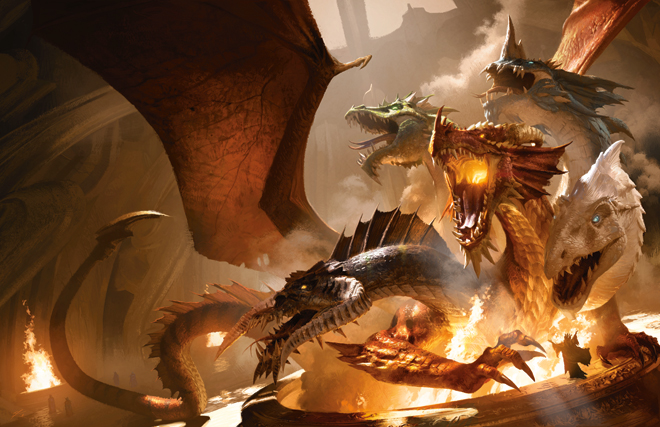
The Rise of Tiamat adventure path. For the uninitiated, this is the second-half of the first "module" for the 5e game. Developed as the second half of the
Tyrrany of Dragons campaign, Wizards of the Coast partnered with Kobold Press (and two veteran designers) to produce this book and its companion,
Hoard of the Dragon Queen. Be forewarned; this is a long, in depth look at a detailed adventure module.
Spoilers Definitely Ahead.
The group I DM for has finished all of the episodes after
(roughly) a year of playing between once and twice a month. It took us
roughly a dozen "sessions" of play time to go through the book's contents.
The sessions ran from small 2 hour evenings (very rare) to marathon 10
hour die-hards (a few times), but on average each session was between
three and four hours.

A bit of a recap from previous entries: We continued the story of the
Lost Mine of Phandelver when starting
Hoard of the Dragon Queen. That is, my players' PCs were roughly level 4, had already completed the sandbox-y
Lost Mine of Phandelver
module and were transitioned into this campaign. I used a transition
that involved placing a connection between an encounter the PCs had
(innocuous enough) in one of the towns in the
Phandelver module
and the first episode in the new book. The connection provoked a journey
that required a few roleplaying encounters and one combat. For my notes
on this transition, see my discussion on the
EN World forums.
The PCs' level advantage did not last long, however; by the end of
Hoard of the Dragon Queen, the PCs were achieving their levels by reaching the end of episodes rather than through raw experience collection. This meant they were on pace to continue achieving levels as expected.
Overall Thoughts:
- Structure: The book itself was very strangely formatted. As Sean of Power Score noted, it seemed like two episodes were crammed into one chapter through most of the book. Similarly, the Council sessions should have absolutely been given their own chapters--it made very little sense to place them all together, and therefore out of order. Book's structure aside, the narrative's structure was really pleasing. The PCs are (generally) offered a choice of two paths--each cemented firmly with their overarching goals--and then given a check in with their "patrons" at the end of their missions. Satisfying, episodic, and lots of fun! Some choice, some "railroading."
- Factions: I can't decide whether to love or hate the way that factions are treated in Rise. On the one hand, having all of the factions be present as benefactors for the party creates a unique environment where it doesn't matter which faction the PCs are members of (and therefore all feel included). On the other hand, there are zero scripted opportunities for the PCs to improve their standing with a faction. That means that after joining factions in Phandelver, and having some sparing, glancing, tangential interaction in Hoard, that they make no further progress as faction members despite being much more influential and powerful heroes! I understand that part of this is my fault--I could have had the factions take a more personal role with them--but I really feel like that's a shortcoming in the text. How hard would it have been to have a few sidebars as to how members of each faction could improve their standing? Some side-quests or even mini-objectives to achieve would have gone a long way. Thankfully, outside of "membership" in the factions, I don't think my party cared overly much about faction rank. As a result, they let that slide into the background and enjoyed being a heroic party of adventurers standing on their own merits.
- Objectives: This is one place where Rise shines. The Council delivers very clear directions, and then leaves it up to the PCs to decide how to achieve those goals. Each episode is relatively clearly defined, and provides a diverse set of problems needing to be solved.
- Grandiose Locales: Hoard provided some truly epic locations (particularly the flying castle!). Rise provided a diverse set of classy, even classic locations on a grand scale: a diviner's forgotten tomb (reminiscent of Indiana Jones and the Last Crusade); a forest dragon's waterfall lair; an ice dragon's iceberg hideout; a council of ancient dragons far from civilization; a forgotten wizard's tower--and it's insidious hedge maze; and, of course, the fight at Tiamat's temple. Overall, I think the diversity of the locations was wild and fun, but not...inspired. There was no single set piece that my players remember as well in this section of the narrative--the floating castle (for example) will haunt their memories far longer!
With the overarching look done, I just want to briefly examine the episodes themselves and give my strongest thoughts on each. It should be noted that
my thoughts below are most useful to DMs looking to run the adventure;
players may feel more bored than usual!
I ran the episodes in the order they were outlined (on page 5, for those following along at home).
One last note is that my PCs started their journey in Phandelver and paid a hefty sum (basically all of their earnings) as we transitioned from
Hoard to
Rise to "rebuild" what had been destroyed by dragons and cultists during
Hoard in the now-growing mining community. As we progressed through
Rise, I gave periodic updates on construction of their new trading post, their Oghman mages' guild, and the defense of the town and trade with other towns as a way of letting them know how bad things were getting along the Sword Coast--this description was tossed in alongside the Council delegates' own narratives of how things were progressing (or digressing) in their own locales.
 First Council of Waterdeep:
This session was a
lot more fun that I thought it would be. Calling the heroes to account for all of their actions and having them retell their story, their motivations--their triumphs and shortcomings--turned out to be a tremendous experience for everyone. For some of my players, this was like being called up out of the audience during a live show and asked to participate in it--finding out that their actions were not hidden in shadow, but were being followed with interest by some of the most powerful figures in Faerun was both scary and exciting for them. It absolutely changed their perspective--permanently!
Varram the White:
The Tomb of Diderius was a delightful dungeon crawl. The PCs were suitably spooked by the random interference of Diderius, adored the ghostly librarian, and were freaked out by the Yuan-ti! Recovering Varram alive--but without the white dragon mask--was a hopeful let down. One of the best moments (for my players) was when the Rogue got bored exploring and jumped on a bed--which just happened to be in the room full of undead. The Rogue was immediately killed--she crit-failed on her death saving throw at the wrong time and
really died. After the collective gasp of astonishment and corresponding silence, the Life Domain Cleric stepped forward and tried out his brand new domain spell--one that brought his fallen comrade
back to life. This, of course, brought no small joy to the party; seldom have any of my players played characters to a high enough level to bring someone back from the dead; this was a reminder to all of them that they had truly reached a heroic level of power, and they rightfully celebrated this victory.
The Sea of Moving Ice:
Oyaviggaton (or "Olive Garden" as my players quickly renamed it) was scary as a set piece. Hunting a dragon in the deep north is not something my players took lightly--they had fought a white dragon before, but on their own terms. As an adventure, this was a tough one to run. For whatever reason, getting the PCs to recognize that the ice hunters were enslaved by fear was impossible. First, they thought they were willing participants, then that they were magically enslaved. Ultimately, they could not win them over, and ended up slaughtering most of the warriors of the village! This was a deeply troubling (im?)moral move, but they failed at diplomacy and persuasion time and time again and this was their only solution left.

Exploration of the caves went well; they convinced Maccath to help them, killed Arauthator before he could escape them, and gained confidence that maybe they
could fight a dragon on its own terms--if they were prepared. They descended into Arauthator's lair without fighting more than one troll and without meeting any of the ice frogs, and soundly defeated him. This was, I think for everyone, a turning point. Here, the adventurers had defeated a dragon on his own terms, in his own lair. This wasn't to say they would throw caution to the wind in the future, but that now they were feeling their own strength.
Recovering Maccath meant the support of Luskan's Arcane Brotherhood and a splash at the next Council. Of course, "your
Draakhorn is in another castle" was pretty unsatisfying.
This was not my favorite piece to run, and if I hadn't seen Chris Perkins run it for a group, I would never have run it so smoothly--not the strongest piece of writing in the text, but cool nonetheless.
Second Council of Waterdeep:
After the cool-factor of the first Council, it was difficult to have the second go-around live up to its predecessor. I tried (and I think succeeded?) in having Elia be a subtle, unnoticed background character, so that initially the PCs were much more intrigued with the possibility of investigating the Misty Forest--until Elia revealed who she was. I chose to delay the Cult Strikes back just a tad, ruling that the cult hadn't had time to realize it was the same group who tracked down Varram that bested Arauthator.
Metallic Dragons, Arise:
I admit it, I set this up as a mini-game or a skill challenge. My players were deeply uncomfortable representing civilization at this ancient council, and needed to understand their purpose in concrete terms. I let them know that their goal was to create trust; I let them know (first through roleplaying the dragon's introductions and then in concrete terms) what these dragons' trust levels started at. The PCs were asked to follow suit: provide a heroic introduction which would establish the characters as valuable allies, competent representatives, and (of course) true heroes.

Cue discomfort.
Our Paladin rose to the occasion (with some prompting) and provided a stellar heroic narrative of himself and his lineage. The rest of the party followed suit and provided amazing roleplaying moments.
The strange thing for our group is that the book seemed to assume that the average adventurer is a human--but our party has two dwarves and two elves (and no humans). The resulting conversation with the dragons went a bit off the rails, but ended well. The largest concession the PCs had to provide was an apology from the elves for the
dragorage mythals.
Running this adventure as a skill challenge (that is, letting the PCs see the mechanics behind the scenes) helped them get over some of their fear of the roleplaying elements. If your group is roleplaying heavy, you can probably do without all of the back-end'ing.
Memorable!
The Cult Strikes Back, Part 1:
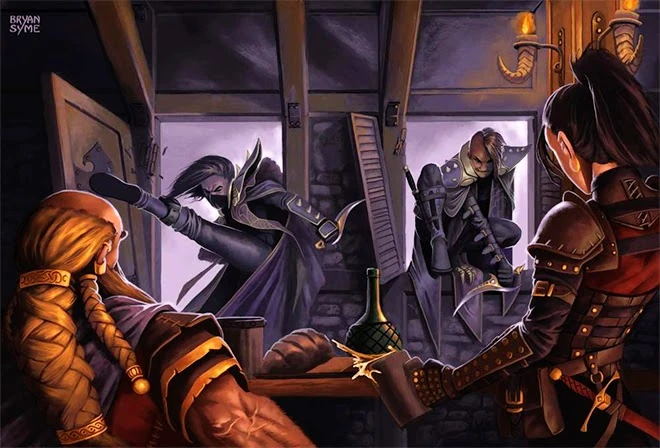
These "assassination attempts" were a bit more fun to run than I'd anticipated. Because the party was relying primarily on a network of teleportation (and their Wizard, by this point, often had it prepared, too), an attack "on the road" seemed difficult for the cult to organize. By contrast, having them attacked in broad daylight in the Council-controlled city of Waterdeep turned out to be a great wake-up call for them that the cult knew them and wanted them dead by any means necessary.
In the first scuffle, a dozen or so assassins tried to pen in the PCs in the middle of a city street. The PCs, old pros in combat, wheeled themselves around and avoided the giant poison clouds that were heading their way--until they realized, by the cackling of the assassins--that they weren't the intended target. As civilians began to choke and die by the half-dozen all around the PCs, they realized what was really at stake here: this was not just another dungeon delve or mob boss or thieves' guild they had come to disband, this was a murderous, widespread, destructive cult--and they needed to be sure they became the heroes they claimed.

The actual fight itself was not deadly for the PCs, but when it was over, some two-to-three dozen civilians had died as collateral damage despite the efforts of the party to interpose themselves between the assassins and their targets.
It was a good roleplaying moment: sobering without being defeatist. When it was over, the Marshall from Baldur's Gate showed up with a mass of Waterdhavian guards to assess the situation. The PCs were immediately found not guilty of anything except recklessness, and urged to be more careful in the city in the future--for their own sake and the sake of its citizens.
Neronvain:
This was one of those quests that could have gone
so badly, but the party did literally
everything they could do to make it right. I thought, initially, that even if they did everything right, it would still be an incredibly challenging dragon fight--and I was wrong. I initially anticipated that, like Skyreach Castle, this was just a giant trap-system waiting to go off.
The party did all of the following:
- Applied the right kind of guilt/pressure to get the Altand defector to confess after tracking him to the secret glade and knowing he was somehow involved.
- Helped a suspicious woman who was "trapped" under a tree, gaining a druid's blessing and invisibility from the lair spies of the Chuth.
- Went into the cave system super slowly, suspicious of why some poorly armed elves would be guarding the caves, and found the "secret door" that allowed them to stumble onto the paddock which held the remaining elf prisoners.
- Convinced the elf prisoners that they were powerful enough to help them escape the dragon--and then, critically, convinced them to go convince the other prisoners (the guards) to escape as well, leaving them free access to the rest of the complex.
- Discovered the disused shrine of Eldath, prayed at it, and received a blessing. This one they never even had to use.
- Scouted ahead and used overkill-style spells to ensure that none of the actual cultists could alert the dragon they were there early.

The first "mistake" they made was in triggering Neronvain's warning glyph. This gave him about a round to prepare himself and the dragon which--as it turned out--was not enough. The party still had almost an entire complement of spells and used them accordingly. They didn't clump together and did their best to hide the casters behind walls while the tank(s) taunted the dragon and its rider. The dragon rider and Chuth (and I!) didn't realize how deadly the PCs were until it was almost too late. Chuth did eventually manage to escape (barely) but Neronvain was shot off the dragon's back as he flew out of the waterfall in a last-ditch retreat.
It was probably more satisfying for my players than I remember, but it was a wake up call as to how powerful they had become; I didn't hold back anything with the dragon or Neronvain but after they did everything so well, there was no "hidden advantage" they could use.
The big disappointment was--once again--not finding a dragon mask.
The Cult Strikes Back, Part 2:
The PCs came back from Altand feeling pretty good about themselves. Suitably chastened by their last encounter inside Waterdeep's walls, they went shopping when there weren't many people about, traveled quickly, and expected no more trouble.
As they traveled to meet the Council for their Third official session, the street they traveled on suddenly cleared except for a small covered mercantile wagon and two porters. Before they could consider why the traffic was so light, the two porters cast off their cloaks, revealing full cultist regalia, tossing magical sapphires onto the street. The sapphires burst into a force-wall which enclosed the section of street the PCs were on, trapping them with the two porters-turned-cultists. As the PCs (cautiously) approached the cultists, wondering why two idiotic cultists would trap themselves in with four very strong heroic adventurers, the wagon burst into splintered wood as the roar of a blue dragon split the air.
Trapped in a relatively small space with two proficient assassins and an angry dragon proved to be a difficult, but not deadly, fight.
As the fight wore on, loud concussive sounds were heard hitting the forcewall, and the PCs were forced to wonder if this was a taste of something worse to come. At the conclusion of the fight, Taern Hornblade shattered the forcewall, letting in a cadre of Waterdhavian guards and mages who quickly dismantled the other half of the forcewall. Again, the PCs were found blameless of wrongdoing, but even Taern was concerned that such drastic measures had been taken to annihilate them: it was no easy feat to smuggle a large dragon inside the city walls!
The Third Council of Waterdeep:
This council was mercurial.
On the one hand, things look bad everywhere: dragons run unchecked, trade has largely stopped, large numbers of villages and townships have simply vanished or fallen out of contact with their patron-states, and news of the dragon attack is fresh on everyone's minds. On top of that, the discovery of Neronvain as a wyrmspeaker had quieted Melandrach into a defeated man: he had already lost his public pride having to apologize for the
dracorage mythal, but that anger he felt deflated completely as his own family turned out to be so responsible for so much suffering.
On the other hand, the PCs had--to the amazement of all--won the help of the goodly metallic dragons. They had stalked and stopped the dragon who had been terrorizing the Misty Forest and the High Forest. They had survived two assassination attempts inside the "safe" city of Waterdeep. They had earned the help of the Arcane Brotherhood. They had, with help from the Council, largely deduced the location of the Well of Dragons.
With flights of dragons defending some of the Council members, and with a good track-record behind them, the whispers of a possible parlay with Thay emerged. Before the PCs could accept this, a magical message brought word of a cult defector at Xonthal's Tower.
As a DM, I think it was important to give them both options and let them choose without penalty because we were so close to the end that to set them on a railroad track now would signal just how close we were!
They chose, with prompting from the council, to check out Xonthal's Tower and make a play for the last unaccounted for dragon mask.
Xonthal's Tower:
Run this exactly as written. Seriously. This is one of the best designed puzzles/challenges I've ever had the pleasure to run. My group of players did a bunch of divinations before starting off, and (through that) I was able to give them one cryptic hint. Something like this:
Follow the shadows; they always point true.
Move now with haste to seek success anew.
The party felt well-armed going into the maze, and--after an appropriate struggle which took them through all of the prepared maze encounters exactly once each--found their way through to the other side. Half of my party was excited and felt accomplished, the other half was ready to murder me. Perfect for a puzzle!
The actual infiltration went pretty smoothly. My players quickly realized that the wall symbols controlled the "televator" (teleporter-elevator) and they started (randomly) going from symbol to symbol (realizing quickly that the "locked" hourglass symbol was the keyed dungeon). They probably used a few too many resources on "lesser" enemies, but they felt that time was running out (as indeed it was). Eventually, they recovered the key and made their way into the dungeon beneath the tower.
They fought and killed the elementals, realizing that they were very nearly out of power and reserves. Choosing to "go it slower," they followed the bloody footprints (with a brief detour to the epic library) and their own intuition and found Iskander's corpse beside the giant hourglasses.
Remember that I had "withheld" the final "Cult Strikes Back" encounter; this is where I dropped it. In addition to Lennithon, I also had the third Cult Strikes Back attack force attempting to level the town of Xonthal's Folly. Still riding high (at least in morale) on their recovery of the blue dragon mask, the party initially dove into battle against the multiple dragons and their cronies. After a mere two rounds of combat, they realized how badly they were outmatched and made the horrifying decision to leave the town to its fate in order to preserve the blue dragon mask (and live to fight another day). As a result of this, they
did not level to 15 for the final fight, and Lennithon lived to fight another day as well. The party hid in the dungeons beneath the tower until they had completed a long rest, then emerged to find the ruins of the town punctuated by crucified and flayed villagers; the dragons and cultists wanted them to know how badly they had failed to protect this town.
In retrospect, I can see where this encounter might appear too challenging for most groups. However, I still think it was the right choice. My players had burned a lot of resources getting through the maze, and more getting through the tower, which they probably could have kept in reserve. They believed themselves invulnerable and so used excess power on things they perceived to be minor threats; this is where that came back to bite them.
Mission to Thay:
I have largely the same complaints that others seem to have about this mission: it's so close to the end that it feels a bit anticlimactic, and (more important to me) the whole mechanic revolves around the party being able to dream.
Since half of my players' characters are elves, I chose to gloss the dream-torture and reduce the roleplaying to a very brief audience with the governor and a few skill checks/saving throws during the "dream sequence" from the dwarves. If I had done it all as written, I'd have been leaving my two elves with nothing to do for far too long!
The PCs narrowly gained the support of the Thayans, and they were just happy their creepy visit to Thay was over.
The Fourth Council of Waterdeep:
I was able to run this at the
very end of a session, which worked out swimmingly. The idea was the Council was called upon to hear the results of the the mission to Thay and of the raid on Xonthal's Tower--word had already spread, unofficially of course, that the party had recovered the Blue Dragon Mask, obtained Thay's blessings, and (regrettably) let a village burn.
This played out as a tense drama: the Council was called upon, one by one, to state once and for all if they were truly committed to the cause; this was their last chance to back out. I had each statesperson give a brief explanation of the events which led to their decision (or, in other words, a brief recap of how the PCs' actions had affected them!). This was both fun, and a nice closing act to mirror the recap the PCs had done for the Council at the beginning of
Rise.
With incredibly narrow margins, the PCs had won the support of each and every faction around the table!
After some preliminary planning, the only delegate missing (Taern Hornblade) busted in, slammed a charred dragon mask husk on the table, and proclaimed (as the last sentence of the session) that the mask the PCs had recovered was as fake. Wonderful cliffhanger for the penultimate session.
Tiamat's Return:

For my players, rather than having them fight their way to the Well itself, I chose a modified skill challenge set wherein the PCs were asked to choose one of two preparatory paths (each). In other words, their characters were in such high demand that they could only help one group with one task. One of the tasks was meant to bolster the character (reward: a magic item) and the other was meant to bolster the party (reward: information about the Well of Dragons or some concrete help during that fight).
This was relatively easy to draw up ahead of time and worked really well. For example, my wizard-librarian had the choice of either raiding a renegade Red Wizard magic cache with the orthodox Red Wizards (magic item) or of going to Candlekeep to research the ritual with which Tiamat was being brought back (a brief incantation which costs 1 action but which delays the ritual for another three rounds--only usable once during the ritual).
Their awesome prep work led them to the least-used tunnels beneath the caldera, and they arrived inside the Temple itself from below, unaware that the sacrifices were still going on outside. My one change to this fight was to add Lennithon in; this made the combat significantly tougher, but was well worth it. The PCs (even with the wizard's spell which bought them an additional 3 rounds) stopped the ritual at the last possible millisecond.
To up the danger/climax level, I also took the "tunnels are largely empty" tack, allowing the party to arrive at the temple's interior at full strength. Partly this is because I think running into a few measly cultists before the biggest fight of the campaign is kind of lame, and partly because I didn't want them wasting anything on pawns since Lennithon would be there.
The fight itself was both grueling and gratifying. Unfortunately, a real-life case of the flu hitting one of the players caused us to take a break in the round after killing Lennithon--about halfway through the fight. The party did--narrowly--avoid allowing Tiamat into the Material Plane.
It honestly came down to me adjudicating the way that Tiamat's entrance is written. I chose in favor of the PC's actions, but it could have easily fallen the other way; it was something that came down to the last second.
There was definitely a sigh of silence when the portal sealed.
To clean it up, I took a page from the cinema book and had Blogothkus (the giant who ruled Skyreach Castle) spellcast a communication to the PCs that let them know that the battle was not going well in the skies above--Blogothkus's castle was going to crash, and he was going to steer it straight into the caldera, smashing the temple in the process. With seconds to spare, the PCs grabbed their unconscious comrades and sped out through the tunnels beneath, hearing the temple shatter and feeling the earth quake as their friend and ally crushed whatever remained of the cultists' power, buried the amassed Sword Coast treasure (perhaps for a future generation of adventurers to seek out?), and brought the campaign's final encounter to a close.
Epilogue:
I kept it simple, but tried to tie in elements of all of the major places and people the PCs had enjoyed on their meteoric rise to power. The bottom line is that while we retired these characters, I don't think we are retiring them for good!
Final Thoughts:
- As a DM who has never run a campaign from start to finish without it ending prematurely (from TPK or real life party break up), I'm as stunned as my players and breathless as it finished.
- As a story, Tyranny of Dragons does a good job of being equal parts mystery and race-against-the-clock.
- As an introduction to D&D 5e, I think it does a fair job of introducing the ways in which the game is played; Hoard of the Dragon Queen offers a much better range of options, but Rise does its part by adding in the dragon set pieces that were missing from Hoard, and having more "true" dungeon crawls.
- Overall, my players and I had a grand time playing it, and with relatively minor adjustments in the grand scheme of things. I would recommend this to a DM who is, perhaps, just starting out, but who is willing to read through the wealth of blogs and forum entries by helpful folks who have dealt with its issues.
 Whew! Level 20 and beyond.