Showing posts with label rules. Show all posts

Saturday, January 20, 2018

D&D 5e: Continued Thoughts on High Level Adventuring

What a weird ride! My players have now conquered the first half of their post-15 campaign (i.e. they've completed one of the two modules I updated). (For my initial thoughts, check out the first post in this series.)

There are some very sharp contrasts between running adventures below 15th, and running adventures after 15th. Here are a few of the things I've noticed:
  1. Travel is completely different. When PCs have daily or routine access to teleportation items, plane shift, and eventually gate, travel is no longer an issue. (For example, even if you don't have access to a teleport spell, two plane shifts or two gates can serve the same function! Yes, it takes two higher level spell slots, but these PCs have those slots!) This changes how PCs conceive of an adventure--and certainly how the DM needs to. No longer is distance in any way related to the number of encounters or the time it takes to journey; characters looking at going from their mountain stronghold into a nearby city and characters looking to travel from that same stronghold to a city on a different continent are likely to consider exactly the same magical--and instant--forms of travel to get there. Even if the characters don't know where they want to go, they have access to a whole bevy of new spells (and/or items and/or NPC contacts) who do know: legend lore, scrying, commune, contact other plane, divination, find the path--each offers another window into the unknown, and having access to a combination of them solves a lot of riddles and mysteries without ever leaving home! The end result is that even if they didn't know where they needed a to go, one hint or clue can lead them to the right place to begin their investigations in earnest within perhaps an hour of game-world time. Gone are the early adventuring days where a single clue would form the basis of a month's adventure to a distant hermit to find an answer to a long-forgotten problem.
  2. Rests are completely different. This is somewhat a corollary to the ideas on travel: because PCs are so incredibly mobile, there are very few times when the right move is not to simply retreat to their magically fortified (and possibly well-staffed) home base whenever they need to rest and recharge. Even if going all the way home is not an option, the PCs may have access to spells or items which are even better than going home. Mordenkainen's Magnificent Mansion (level 8) presents an opulent version of a home away from home, but even a Leomund's Tiny Hut (level 3) can get the job done, offering PCs time to rest and recharge for either a short or a long rest. In addition to the travel changes removing a lot of the "random encounters" on the road, the rest protection options remove many of the dangers of "taking a rest." Only time remains to consistently work against these high level PCs!
  3. Fights are extremely swingy. High level monsters hit often and they hit hard. High level PCs
    do the same. Similar to the first few levels of adventuring, it becomes really important that the party tanks (or those with high hp) are taking the hits, while the squishier members of the party are free to control the field or deal damage. Spells that cause an opponent to lose an action or which limit the kind of actions they can take become useful (in my opinion) for the first time. Causing a goblin boss in a low level fight to sacrifice an action is no big deal; an action may have done some damage, but realistically he probably has surrounded himself with a horde of lower level goblins who can deal almost as much damage in a round! On the other hand, causing a dragon, an eight-armed sword-fighter, a high level warlord, or a wizard with 9th level spells to lose an action is tremendous. Each one can do a tremendous amount of damage (or exert a lot of control) in a single round, and forcing a delay tilts the action economy into the hands of the PCs rather nicely. PCs at this level are even more resilient than I had first believed they would be; even when fighting a variety of opponents--each of whom, on their own, would be a worthy challenge for the PCs--the wide range of abilities and synergies the party has access to made them incredibly powerful. The big boss fight at the end of the adventure was spectacular, but when the dust settled, the PCs could probably have done another fight of equal caliber and survived. Then again, it's possible that the PCs could have made one poor choice and the whole fight would have become a rout.
  4. Even experienced players (and DMs) feel uncertainty. A D&D player from any edition knows what to do when they encounter magic missile, cure light wounds, a locked door, or a new +1 longsword. They've seen all of this before in a dozen, even a hundred iterations. But how many times have players had access to wish? When you're dealing with entirely virgin territory, it's natural for all people involved to feel a bit uncertain. This is both the fun and the terror of the high level campaign. All of my players made some amazing choices and did some epic, heroic feats over the course of the adventure. One that sticks in my mind is when our cleric prayed to his god (Moradin) for intercession to resist the heat of the unholy furnace the party was headed into. Because his character is such a high level, the odds were significantly better than they would have been normally, and a good roll meant that Moradin granted the prayer! The fire resistance the party picked up was (in my opinion) the difference between an easy boss fight and a potentially deadly one. Without a wizard, this party managed to magically solve a problem they didn't legitimately have a spell or a magic item for. That is high level adventuring at its finest.
As this party of characters moves into what will likely be their final adventure together, they're all
level 18. Those high level abilities most players only dream about their characters having are a reality--or just one or two short levels away. For me, it's going to be a challenge to challenge them. High level encounters each have to be set pieces; no more random bandits or wandering monsters, no more minor problems or careless issues. For these characters to be involved, the threat to the world has to be real, imminent, and disastrous!

And it is.

Stay tuned for more thoughts on high level adventuring as my players take their characters to the brink and maybe a bit beyond!

Wednesday, March 15, 2017

D&D 5e: Sight Unseen

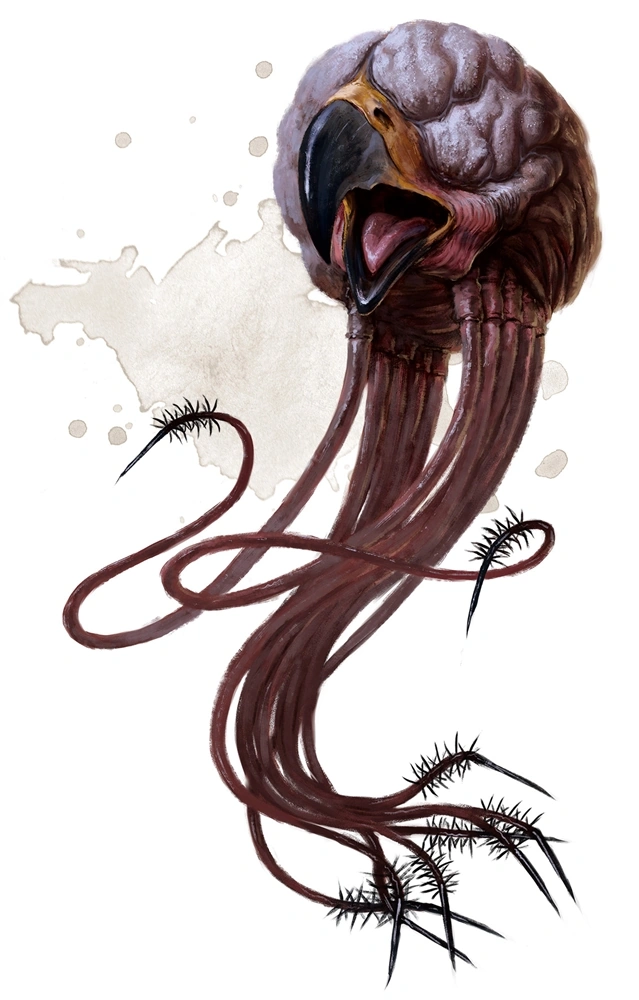
As I was tinkering with Out of the Abyss, one of the challenges has been dealing with the light (or perhaps I should say 'dark') situation in the Underdark: the races who live there naturally have adapted to the lack of sunlight, but not necessarily to a total lack of light. Even those races which have innate and extensive (120') darkvision still tend to use fire--either magical or mundane--to light their settlements or to create artistic effects. Still, I thought, there have to be some creatures that don't use light, abhor it, or (at least) don't seek it out.

I scoured the internet for lists of fantasy monsters, creatures, and humanoids who would be considered "blind," but I couldn't find anything comprehensive. As such, I thought I'd save everyone the time I went through and list what little I did find with my notes! I'm particularly interested in creatures whose eyes don't work, so I'm not looking for creatures with extra senses in addition to sight, but rather those that lack sight.

Constructs:A few constructs are granted magical sight which doesn't rely on "eyes" and which allows them to perceive a limited space around them. Animated Objects and Helmed Horrors (but not golems) fall into this category.

Burrowers:
Chances are that if it spends its life digging through the dirt, it doesn't need eyes to do it. Ankhegs are an example of these sightless monsters. On the more ferocious end of things, Purple Worms are both deadly and blind!

Plants and Oozes:
Most plants and mindless oozes are eyeless, relying on other senses. Blights and Shambling Mounds are examples of these plant-based creatures, as are fungi like Gas Spores, Shriekers, and Violet Fungus. While Myconids can see, their creations (Spore Servants) cannot.

Broken Undead:
Pieces of larger creatures that have been reanimated often function the same way that constructs do--using magic to perceive the world. Crawling Claws are an example of this kind of reanimated creature.

Blind Animals:
While we might think of bats as typical of this category, there are other monstrosities and beasts who don't rely on sight. Darkmantles and Gricks are examples of this.

Aberrations: 
Aberrant creatures cover a multitude of alien beings, some of whom are native to worlds without sight. Grell and Intellect Devourers are perfect examples.


Humanoids:
This is a very small category--unless you count clumsy carpenters and kids with BB-guns. Grimlocks
are degenerate humans who have, over centuries, lost their eyes and gained blindsight.

...and that's all!

The bottom line is that the ability to inflict blindness is a much more practical ability than I had initially thought, and that most--almost all--creatures have some kind of traditional sight (although that sight may be augmented by more alien abilities and senses).

Wednesday, February 8, 2017

D&D 5e: Out of the Abyss (Part 1 of 2)

It's taken a long time for my group to play through the first half of Out of the Abyss: it's been almost a year!

Unfortunately, I don't have much more to add (that isn't already out there), but here are my thoughts.

Pros:
  1. New and Different: The entirely alien feel of the Underdark allowed most of my players (who usually play largely conventional races) to try out being traditional outcasts. Instead of a mostly "traditional" race group with a single outlier, it's the opposite: one surface dwarf amongst two drow and a deep gnome!
  2. Fear and the Bizarre: Not knowing how things work in the Underdark made for some very cool interactions between PCs and locales. They were constantly asking who they could trust and where they should go next!
  3. More Common Magic Items: I don't know how it compares to Curse of Strahd or Storm King's Thunder in terms of the commonality or abundance of magic items, but in terms of Tyranny of Dragons and (to a beginner's view) Princes of the Apocalypse, magic items are much more plentiful and much less likely to "break" the game.
  4. Fun NPCs: The always-different and always-curious stories of the jail-break NPCs (and the wacky characters the PCs met along the way) are exciting, fresh, and engaging. While it was a pain to control a whole extra party worth of characters, there were ways to keep combat from dragging. Glabagool stole the show.

Cons:
  1. Repetitive: For how wild and crazy the Underdark can get, the issue of travel from one place to another quickly becomes tedious if following the rules as written. Once the characters were strong enough to muster their own resources, we had to drop keeping track of supplies before that consumed the vast majority of our sessions.
  2. Asymmetry: Because of the sandboxy nature of the module, threats were not evenly spaced or scaled. On the one hand, I want to applaud this! The fact that the PCs are having to worry about the potentially deadly encounters they might face is excellent. The problem was with the lower end encounters. As the party made its way into each new city, they were blowing through many of the encounters. This meant I had a choice: narrate the fights or let my party spend a half an hour cautiously figuring out how to beat them. As a result, I feel like they're getting too comfortable--that only "big" fights are actually going to play out. As a result, they feel like they can expend all their abilities on the fights that "actually happen." I'm still trying to figure out how to tweak this for the second half.
  3. Tedious NPCs: The jailbreak NPCs were clever and fresh--but also cumbersome. Even though I handed off combat control of most of the NPCs to the players, it was a problem to have to consistently roleplay them while still giving PCs pride of place. Often, I felt as though their traveling companions were either helpless or overbearing--as their personalities dictated--and so it became a game of "is there a reason these NPCs can stay behind?" 
  4. Underdark Parties Not Welcome: Though this was billed as a chance for characters to "try something different" and be from an Underdark race, most of the adventure is written from the perspective of a party of surface races. As a result, a lot of the really fun read-aloud text was just plain boring. Similarly, many characters had entirely unscripted reactions to the party (i.e. the "script" calls for them to hate a party with elves in it--or humans, or gnomes, or whatever--but there aren't any in the party.)

Overall:
 The cities shine brightest. Being able to bring my friends to the depths and show them Blingdenstone, Neverlight Grove, and Gracklstugh was awesome. The characters they encountered there were interesting, even fascinating. As usual, the interactions faded fastest into the background, but never faded entirely. As they explored the depths, the slow accumulation of stories (madness! destruction!) had a wonderful slow fuse that allowed us all to savor it.

Bottom line? It's good, but it's not great. We'll see how the second half goes.

Sunday, May 8, 2016

D&D 5e: The Artificer Class, Unveiled!

For the last many months, I've been working on how to create an Artificer class which would work under the D&D 5e rule set. With the advent of the new SRD, I was able to justify spending the additional time to attempt to polish and eventually publish my ideas.

As such, I'm happy to unveil the Artifice class for 5e on the DMs Guild website. You can download your copy for free (or you can chip in a donation if you feel like it).

Here's the link: Artificer Class

If you're coming to this site for the first time and you're interested in some of my thought process on how the class was developed, you can check them out here on the blog. Roughly, the development followed these steps:
  1. The Overview of the Problem
  2. Permanent Item Creation
  3. Infusions and Class Features
  4. Archetypes and Finishing Touches 
Of course, even after the fourth blog post, I worked for another few months (on and off) to refine the design. Ultimately, it needs some play-testing from new eyes to really get any remaining kinks out!

Please feel free to drop some commentary in the comments; I'm looking forward to updating this little labor of love.

In the meantime, if you do give it a quick read-through, don't forget to rate it!

Thursday, March 31, 2016

D&D 5e: What DMs Can Learn from Adventure Time (Part 1)

Adventure Time is a (young) D&D player's dream: an adolescent inhabits a world of magic, technology, and candy which is at once both sinister and sincere. Adventure Time offers a few things which I think are, if not unique, certainly special. Let's first examine what Adventure Time has in common with D&D (or other RPGs). There are other television shows and books that could entice us, but Adventure Time:

  1. Centers around the exploits of a small band of adventurers.
  2. Is story-driven, while remaining character-focused.
  3. Reveals a world in which magic plays a substantial part, but which is still shockingly similar to the world in which we live.
  4. Has rules and laws which govern its physics, which are playfully loose compared to the "real world."
So how does any of this help me as a player or a DM?

Let's look a bit closer at how the show appeals to us.
     1. Centers around the exploits of a small band of adventurers.
     Finn and Jake are (step?) brothers. They didn't meet at at a tavern, and they didn't decide to "hook up" to slay a goblin raiding party. Finn and Jake have an inherent connection that they don't question. As the story moves on, we find out more and more about their family dynamic (Joshua the Warlock?), but the key here is that the characters backgrounds are both set in stone and dynamic. They have a reason to work together, but that doesn't mean it's boring or uninteresting.

    Adventurers don't need to be randomly thrown together; the most interesting characters have a connection right from the start.

    2. Is story-driven, while remaining character-focused.

    This may sound like a "duh" statement in today's character-driven landscape, but it still bears a brief comparison to some of the best 20th century literature from which the fantasy genre grows. Consider The Hobbit as the prime adventure story of the last hundred years: a character is driven from the familiar to the unfamiliar, meets a cast of unlikely but heroic characters, encounters magic, and eventually triumphs over both himself and his surroundings, returning home a changed individual.

    Now think about it again: outside of Bilbo, and (on his deathbed) Thorin Oakenshield, do any of the characters truly develop through the story? I don't mean to start a Tolkien deathmatch, but of the fifteen members of Thorin and Company, only one & a half are really characters in the way we'd address them today. The fun in The Hobbit comes from seeing this gaggle of dwarves get into trouble & having Bilbo or Gandalf figure out or luck out & save them.

    Adventure Time offers something different. Not only are Finn and Jake incredibly human creatures  who learn, love, and change, but the majority of the creatures and beings they encounter regularly are similarly "real." The random creature/character on the road side can be (alternately) incredibly important or nondescript and unnamed.


    Perhaps most clearly, Finn's hidden past drives the story--but how he and others react to that past is what keeps him real, and keeps us invested in the story itself.

    The cast of a story needs to react to the story, and the story needs to react to the cast of characters. Don't let one overpower the other.

    3. Reveals a world in which magic plays a substantial part, but which is still shockingly similar to the world in which we live.

    Jake is a magic, talking, stretching dog. Right from the get go, magic is taken as normal. At the same time, Finn is shockingly ordinary. At the start of the episode "Web Weirdos," Finn and Jake do some "stunts." Jake does some amazing parkour, and Finn is capable of being excited about a level of "climb and jump" which is (intentionally) laughable by comparison. This kind of contrast is necessary for the kind of wonder and awe that D&D worlds should evoke in our players (if not always our characters)!

    For every fantastic dreamscape, floating castle, or kingdom of living ice, include a haggling merchant, a hungry pauper, or an angry mother-in-law. The magic must exist with the mundane or it simply becomes the new mundane.

    4. Has rules and laws which govern its physics, which are playfully loose compared to the "real world."

    Finn and Jake are constantly getting beaten into bloodied pulps, transformed into other creatures, shrunk, enlarged, stranded without supplies, or outright zombified. Yet, by the end of the episode, all is right with the world again (even if Finn does lose an arm in the process). Pain is a reality, but not a crippling one.

    Speaking of supplies, where in the world do Finn and Jake do their grocery shopping? Outside of the occasional pie from TT and meat from "Meat Man," they don't seem to have a home garden for veggies or a local supermarket to pick up their foodstuffs (though occasionally one or the other of them will "go out" to get supplies). Do we ever question this?

    Unless it's really important where the foodstuffs come from, we're much more interested in the songs Jake sings about bacon pancakes than about where he got the bacon or batter in the first place.

    As one of my players recently said, we play D&D to get away from managing our day-to-day affairs. It doesn't matter where the bacon pancakes come from, or how the fighter keeps swinging even though he's been at 1hp for twenty minutes.

    That's all for Part 1! Stay tuned for Part 2 where I'll look at some other important lessons from Adventure Time.

    Monday, February 22, 2016

    D&D 5e: Planning for Out of the Abyss

    While the group I DM for is still working its way through Tyranny of Dragons, I've had my eye on Out of the Abyss since it was released, and received my own copy at Christmas. I've started reading through it, thinking about how to prepare it for play, and thought I'd share some of my thoughts on modifications and adjustments (as well as simple execution tips).


    ***SPOILERS DEFINITELY AHEAD***

    You really don't want to read any further if you're going to be playing in an Out of the Abyss campaign.

    Even when other bloggers and commentators had begun to discuss it, I knew Out of the Abyss would be handled a bit differently--that even more than Tyranny, it would be testing (at least my!) DM skills. This was only confirmed further when I read Power Score's review/read-through of the adventure path. I highly recommend reading Power Score's read-through on this. It might take a while, but it's worth it. At least read through the first few chapters. (Don't worry, I'll wait.)

    All set? Okay.

    Power Score's read-through brought a few things to my attention that I saw more clearly in my own read-through:
    1. The adventure relies on a lot of traveling. How that traveling is handled will determine a great deal of the success of the adventure as a gaming experience.
    2. The layout of the book is not linear. How a DM navigates the book and what is or is not at his/her finger tips at any given time will dictate how cleanly a DM can cleave to the "as written" adventure.
    3. The ability to prep random encounters or travel encounters ahead of time is not clear. The sandbox nature of the adventure, along with the sliders of travel speed, party size, party composition, and "getting lost," all factor into how a potential path comes together. To put it in traditional terms, this adventure has a ton of moving parts.
    Traditionally, a set of random encounters can be readily generated ahead of time by simply plotting out the PCs' course and rolling out where the encounters will be along the route. My gut instinct was to do this, and it looked something like this:

    Day 1: Travel: No encounter
    Day 1: End-of-Day Camp: No encounter
    Day 2: Travel: Terrain encounter
    Day 2: End-of-Day Camp: No encounter
    Day 3: Travel: Terrain and Creature encounter
    Day 3: End-of-Day Camp: No encounter

    ...and so on and so forth.

    Unfortunately, this kind of prep work doesn't take into account what happens if the party gets lost, and doesn't take into account different pacing.

    At least with regard to the travel in Chapter 2, I chose to combine the "Summarizing Travel" rules and the traditional ahead-of-time-prep.

    The key is to stop looking at travel as a function of "days" and to start looking at it as a function of miles. By looking at travel in terms of distance instead of in terms of days, it allows for the party to change speed at will, and still to account for encounters at an appropriate pace.

    To the left is what one of those travel maps would look like, represented as a single arcing line of squares.

    The two shaded squares represent the starting (upper left) and ending (middle right) points.

    As is listed on the sketch, each square represents two miles of travel. (The scale is because the travel speeds are all listed in even numbers.)

    "-C-" indicates an encounter that happens when the PCs camp after passing the indicated point. A "-T-" indicates an encounter that happens as the PCs pass the indicated point. I determined these somewhat at random, occasionally even allowing a camp encounter to be a terrain one (having the PCs reach a cool terrain feature at the end of their "day" of travel).

    A single page (like this) can sketch out the encounters the PCs would encounter across hundreds of miles in a compact, easy to generate way. I think this particular page took less than 15 minutes to generate, and would probably take my players at least one full session to get through. I made a second page like it to track the number of hours the PCs may spend while lost, and the additional encounters they might run into while not making progress toward their destination.

    One other change I made is in the frequency of encounters. Chapter 2's summarizing rules ask for 1d6+1 days between encounters. Since these encounters don't always involve more than a short narration and many don't involve a real challenge--let alone combat--I thought this seemed a bit sparse. My first rolls indicated a journey of a hundred miles with only three encounters and no combat encounters. (For those of you following along at home, the trip from Velkynvelve to Sloopbludop only had a single non-combat, non-challenge encounter.)

    To remedy this and up the danger level (something my players felt was lacking in my running of the Tyranny of Dragons arc), I decided to alter the frequency rolls. First, I had to convert "1d6+1" days into miles. My conversion is this: 1 day = 6 miles. Second, I lost the "+1", making an encounter each 1d6 (x6) miles. If the encounter I rolled was not a challenge for the players (for example, a non-combat encounter that didn't increase the drow pursuit), then the next time I rolled, it would be 1d6-1. If I got another non-challenge encounter, it would become 1d6-2 in the next case. When I rolled a zero or a negative number, I employed an absolute floor of 4 miles between encounters.

    I haven't had a chance to run this yet, so it's possible that this will be too deadly, but I think this is an appropriate modification.

    Happy prepping!

    Monday, February 15, 2016

    D&D 5e: Solving the Artificer Problem (Part 4)

    Many months ago, I began considering the problem of how to bring an Eberron-style Artificer class to life in 5e. I continued that line of thinking into how magical item creation might function, and then considered how to deal with infusions. As stated at the end of that third article, I think it's time to consider how the class's features will look, and to consider what a basic archetype might look like.

    Let's take a look at a "generic" class chart (without any archetypes):


    So, how to flesh this out? Let's start with the simple stuff:
    -----------------------------------
    Class Features:
    As an Artificer, you gain the following class features.

    Hit Points: 
    Hit Dice: 1d8 per Artificer level
    Hit Points at 1st level: 8 + your Constitution modifier
    Hit Points at Higher Levels: 1d8 (or 5) + your constitution modifier per artificer level after 1st.

    Proficiencies: 
    Armor: Light armor
    Weapons: Simple weapons
    Tools: Thieves tools and one other tool set of your choice

    Saving Throws: Intelligence, Charisma
    Skills: Choose two skills from Arcana, History, Investigation, Medicine, Nature, and Religion, then two additional skills of your choice.

    Infusion Magic: 

    As a tinkerer and meddler in all things magical, you have learned how to create infusions of magical power. Through a unique and idiosyncratic combination of intuition, scholarly training, and observation, you've learned to infuse ordinary objects with magical power. In many ways, this allows you to mimic spells cast by more conventional magic users.

    In order to create an infusion, you need to have bound yourself to an Artificer focus. This focus can be mundane or magical, but it must be present on your person to cast infusions. Infusions work in one of two ways; if the spell has a range of touch, it must be cast onto an item/object; if the spell has a range greater than touch, it is cast into or through your focus.

    You may bind yourself to a new focus during a long rest; this removes your connection to any previous focus.

    Use the Wizard spell list to learn your spells from.

    Cantrips:
    You know two Wizard cantrips of your choice from the Wizard cantrip list. You learn additional wizard cantrips of your choice at higher levels, as shown on the Warlock Cantrips Known table.

    Spell Slots:
    The Warlock table shows how many spell slots you have. The table also shows what the level of those slots is; all of your slots are of the same level. To cast one of your Wizard spells of 1st level or higher, you must expend a spell slot. You regain all expended spell slots when you finish a short or long rest. Starting at 13th level, your spell slots become 6th level.


    Spells Known of 1st Level and Higher
    At 1st level, you know two 1st-level spells of your choice from the Wizard spell list.

    The Spells Known column of the Warlock table shows when you learn more Wizard spells of your choice of 1st level and higher with one exception: starting at 13th level, your spell slots become 6th level. A spell you choose must be a of a level no higher than what's shown in the table's Slot Level column for your level.

    When you reach 6th level, for example, you may learn spells of 1st, 2nd, or 3rd level.

    Additionally, when you gain a level in this class, you can choose one of the wizard spells you know and replace it with another spell from the wizard spell list, which must also be for a level for which you have spell slots.

    Spellcasting Ability:
    Charisma is your spellcasting ability for your Artificer infusions, so you use Charisma whenever a spell refers to your spellcasting ability. In addition, you use your Charisma modifier when setting the saving throw DC for an Artificer infusion you cast and when making an attack roll with one.

    Spell save DC = 8 + your proficiency bonus + your Charisma modifier

    Spell attack modifier = your proficiency bonus + your Charisma modifier

    Artificer Insight:
    In your experience dealing with magic and magical devices, you have discovered--whether through intense study, sheer luck, or repeated experience--how to use an infusion to mimic a magical spell you have witnessed, studied, or developed that is of a spell level you can cast (as an Artificer).

    Starting at 2nd level, you learn two new spells of your choice from any spell list; you will cast these as infusions. Additionally, when you gain a level in Artificer, you may choose one of your spells learned from Artificer Insight and replace it with another spell of a level you can cast (as an Artificer).

    You learn an additional spell of your choice at 7th (total of 3), 12th (total of 4) and 17th (total of 5).

    Magical Item Creation:
    Your insight into the nature of magic and its interactions with the physical world make you uniquely suited to creating a wide variety of magical items, both permanent and temporary, even if you lack the normally associated skill set. Use of this class feature is entirely up to DM discretion.

    Starting at second level, you may create Spell Scrolls for spells you know. You may similarly work with other spellcasters to create Spell Scrolls for spells that they know. You may only create Spell Scrolls for spell levels which you know (or for levels of infusions you are able to cast). An Artificer may scribe a scroll for a spell without using up the source. For example, an Artificer may duplicate a scroll in his possession, may mimic a spell from a wizard's spellbook, or may scribe a scroll from a spell known by a cooperating and ever-present spellcaster who is assisting in the preparation and crafting of the scroll.

    [Assume this description is much longer, banking off of the magical item creation discussion in the previous entry. See that article for details.]

     -----------------------------------

     Not bad! We've waded through the initial crunch, but now it's time to consider the third level and (likely) the archetypes. For our purposes, I'm going to start with thinking about the three possibilities I came up with in my last post on this subject and go from there:
    • the Wandloren (an implement-focused Artificer who ekes additional life and utility out of magical wands, rods, and staves to make them more potent)
    • the Tinker (a true jack-of-all-trades who dabbles in many skills and magics, rivaling the bard in esoteric knowledge), 
    • the Mechanist (a magical craftsman who seeks to make machines, homunculi, and other golems or golem-like creatures)
    • the Magewright (an artificer who seeks to become a better spellcaster through creation/use of magical grimoires and other implements) 
    If we take the Wandloren as our "standard" archetype, then perhaps it will look like this:

     -----------------------------------

    Artificer Archetype:

    At third level, you choose an archetype to assume in the pursuit of magical knowledge: Wandloren, Tinker, Mechanist, or Magewright. The Wandloren is detailed at the end of the class description. Your archetype choice grants you features at 3rd, 6th, 10th, and 14th.

    Ability Score Improvement: 

    When you reach 4th level, and again at 8th, 12th, 16th, and 19th level, you can increase one ability score of your choice by 2, or you can increase two ability scores of your choice by 1. As normal, you can't increase an ability score above 20 using this feature.

    Artifice Mastery:

    At 18th level, you have achieved such complete control over magic's interactions with the physical world that you have developed a few foolproof infusions which you may use at will. Choose a 1st-level Wizard spell and a 2nd-level Wizard spell that you know. You can now cast those spells as infusions at their lowest level at will without expending a spell slot. To cast either infusion at a higher level, you must expend a spell slot as normal. 

    By spending 8 hours in study, you can exchange one or both of the spells you chose for different spells meeting the same criteria.

    Grand Artifice:

    At 20th level, your well of inspiration becomes nearly limitless. You may draw on inner reserves of magical power by spending one minute in contemplation of the problem or challenges that lie before you. Regain all of your expended spell slots from the Infusion Magic class feature. You must finish a long rest before you can do so again.

    Artificer Archetypes: 

    The Wandloren:

    As a Wandloren, you are a versatile spellcaster whose strength lies in creating temporary magical implements and in maximizing the potential of more permanent magical devices. You've devoted your life to the study of wands, rods, and staves. Even the simplest non-magic stick can instantly become a magical implement in your expert hands, so attuned are you to the pathways that magic takes through such objects.

    Tempered Baton:

    At 3rd level, you have learned exactly what differentiates an ordinary bar, baton, or stick made of metal, bone, or wood (or other suitable material), from a magically treasured wand. Once per day, you may attune yourself to a non-magical bar, baton, or stick, imbuing it with one spell of your choice from those you are capable of infusing. This attunement takes a minute, but is otherwise follows standard attunement rules. Though the device you've created functions exactly as a wand, it can only be attuned to you and will only retain its magic until you take a long rest. You may use your Artificer Focus as your tempered baton.

    The spell you choose cannot have a casting time of greater than one action, must have a spell level of three or lower, and cannot have a costly material component.

    The tempered baton you create has 1d3+2 charges, and becomes a simple non-magical object when the final charge is expended. Many Wandlorens have a favored object which they give a pet name and imbue each day. 

    Implement Extension:

    At sixth level, your control over wands and other magical implements has been greatly improved, coaxing even greater magics from your chosen wands. When you create your tempered baton, your creation has 2d3+2 charges. Additionally, any other single permanent magical wand in your possession is considered to have two additional charges per day (or other period, as specified by the wand). 

    Instead of a wand, you may endow a rod or staff with one additional charge.

    In addition, you recognize magic wands simply by handling them; even the briefest physical touch lets you know the wand is magical. If you handle a magic wand for at least one full round, you know the spell stored inside as well as how many charges it has, when it recharges, and any other conditions affecting the wand's use.

    Strengthened Implement: 

    At tenth level, you begin to use your own power to push the limitations of wands and other implements. When you create your tempered baton, your creation may store an additional spell of first level with its own 1d4+1 charges. 

    In addition, your Implement Extension feature is improved: you may now endow a rod or staff with two additional charges, or a single permanent wand attuned to you and in your possession is considered to have three additional charges (per day or other period as specified by the wand).

    Wand Virtuoso:

    At fourteenth level, your level of control and expertise over wands becomes so extensive that wands cannot completely fail you. When you expend the final charge of a wand, roll a d20. On a roll of a 1, the wand is not destroyed, and on a roll of a 20, the wand regains one charge. This also applies to your tempered baton (which, on any roll but a 20, does lose its magical status granted by your Tempered Baton feature).

    A Wand Virtuoso is capable of breaking the laws of magic as they pertain to magical implements. Your expertise in implement magic allows you to imbue a standard melee weapon--magical or nonmagical--as your tempered baton. You still need to attune yourself to the weapon to use the wand functions as usual, but can now cast spells while wielding the weapon, rather than needing to have a the wand drawn separately.

     -----------------------------------

    Let's take a look at what this class progression looks like with all of these features in place:


    ...and there it is! A (preliminary) 5e Artificer. To stay true to the original, I tried to stress versatility over expertise.

    Let me know what you think in the comments. I think this might be ready for play-testing! My early thoughts are this iteration of the class will be wildly powerful at the mid-tier, low-powered at the beginning, and will start to fall off by the highest tiers of play.

    Monday, January 11, 2016

    D&D 5e: The Game That's Not a Game

    Most games--whether tabletop, virtual, or purely social, can be played by pure "rules." That is to say, for example, that when playing poker, solitaire, or even your favorite side-scrolling platformer, your investment in the game can be as shallow as your investment in the rules and you can still beat the game and potentially have a great time doing it. The fun you have while playing the game can come from "overcoming" the game through the structure of the rules. A quick google search of "beating [insert video game here] in record time]" reveals how people have created a whole realm of gaming experience around the speed at which a game's structure can be surmounted in order to win. And, in some settings, that can be fun.

    Dungeons and Dragons and other tabletop RPGs, however, are a game style in which beating the game in record time or by surmounting the rules is not the usual way to play and enjoy; in fact, the only "record times" Dungeons and Dragons players appear to care about are the longest running games.

    Because of this important but often overlooked difference, I thought it might be useful to consider the two ways to look at Dungeons and Dragons and how seeing the game through these two lenses might enhance enjoyment of it and (occasionally) speed us through the "work" of the game and emphasize the areas that are the most fun. In other words, sometimes D&D is a Game. Other times D&D is Not a Game.

    The Basics:
    If this concept already makes sense to you, skip down to the advice! If not, read the two sections below for a more full explanation of what I mean.

    The Basics: D&D is a Game:
    This is the obvious way to look at it if you play with min-maxers, rule-wizards, or number-crunchers. When you play the game and always consider that it's a game, you constantly meta-game, you tend to consider your character as a very valuable but ultimately expendable resource, and it becomes much easier to think of your quests/missions as means to an end (leveling up or loot) rather than anything else.

    The Basics: D&D is Not a Game:
    This is the obvious way to look at it if you play with role-players, what-ifsters, actors, story-tellers, and (often) young children. When you play the game but immediately lose yourself in the pretend, in the narrative, in the story, you tend to think of in-character solutions, you think of your character as a person--requiring food, water, rest, entertainment, and having real emotions, reactions, and aspirations. It becomes much easier to pursue quests/missions related to your characters goals, and choosing new abilities or powers becomes a natural extension of your character's growth as an individual.

    The Advice:
    Many, many writers and gamers have tackled the relationship between these two, so I just want to focus on some ways these perspectives can be leveraged to help your game time be more fun and worthwhile! I try to take problems that arise from looking through one of the perspectives, and offer a solution grounded in the opposite perspective. Sometimes that's all it takes.

    One last disclaimer is to take these first and foremost as tips to enhance your enjoyment of the game, and second as distinct items belonging under the heading I've placed them--this is a very loose framework!


    The Advice: D&D is a Game:
    • The Ten-Minute Round. When in combat, I often see gaming groups get hung up on "which spell is the optimum choice?" or "should I strike at this enemy, or that enemy?" If this is really a meaningful choice (for example, if you're the last man standing and have to decide with absolute certainty how to survive the encounter and revive your friends) then I understand some deliberation. However, in most cases, I feel like this is players taking advantage of the fact that they have far more than 6 seconds to determine what's going on in a round to the point of it becoming a detriment to the game (if not to their characters). 
      • Solution: When you're not sure what to do because the choice isn't a meaningful one, use a cantrip, pick a target, or swing that sword. Does it really matter whether you wiped out the enemies this round or whittled them down over a few rounds? Does it really matter if you attacked the goblin who was threatening the cleric or the goblin who was threatening the rogue? Probably not. If you make a snap decision, chances are it's the right one--and you have everyone else's turns to think of something clever or "better" to do when your turn comes up again.
    • The Thumb of God: Sometimes players--or DMs!--get into an adversarial mindset. They start thinking of a campaign as something where success is defined as out-thinking the person(s) on the other side of the screen. This is a common trope in D&D humor:
      Still, it can cause its share of drama or problems. The minute you start thinking the DM is out to kill you (or that the players are out to "ruin your story" or some such nonsense), you stop creating a communal narrative that allows the characters and the world to shine. I know this line of thinking tempted me when I was running an early session in Rise of Tiamat; my players transformed "Oyaviggaton," into "Olive Garden" and made one of the creatures there ("Marfulb") into "Marlboro."
      • Solution: Even if you suspect that the DM is out to kill you, or that your players are in a particularly comedic/dramatic mood when you've set what you believe should be a dramatic/comedic session, just let it ride. Obviously, if it's a long-term issue, talk about it when you're not mid-game, but in the short term, get your head back in the game by not thinking of it as a traditional game. To refer back to my example above, the renaming was just a strategy my players were employing to (A) lighten the dark mood and (B) remember who was who among many complicated names. They were still vested/involved, and since I accepted that, we were able to have a very fun and intense session--despite talk about Olive Garden's night manager and whether or not the Marlboro Man worked there too.
    The Advice: D&D is Not a Game:
    • Realistic Villains. I've mentioned this elsewhere, but it bears repeating: I sometimes see groups thinking that just because they've found the villain or monster they've been looking for, that he/she/it is just going to throw everything at the PCs and (when it becomes clear that the end is near) cry out some last words and die. For some reason, players are shocked when the villain uses invisibility and runs away, or kills the hostage when the players come closer, or in any way has an escape plan ready to go. 
      • Solution: Remember that this isn't a video game where the boss blinks red as you get closer to killing him, and stays on screen while you hammer away at him. Villains are "real people." If they're smart enough to orchestrate a devious plan that took several levels and multiple dungeons to sort out, chances are they have an escape hatch or two in case things go south. The sooner players see the villains as "real," the sooner they start looking for those escape hatches, the sooner they take the villains' hostage situations seriously, and the sooner the enjoyment comes as much from the drama of the showdown as from the death/defeat of the villain(s).
    •  No Good Feat Goes Unpunished. Thankfully, 5e has done a great job of curbing the min-maxing tendencies of 3e through a herculean achievement of game balance. Still, when a party levels up and hits one of the ability-boost levels, sometimes a player hits upon a feat that really stands out for his/her character. This can leave other players searching feverishly for a power boosting feat that just doesn't exist for their character build. 
      • Solution: If you really don't want to just take the ability boost (which, by the way, is almost always as-if-not-more powerful than the feat options), choose a feat which adds flair and character instead. For example, one Rogue in a party I DM for chose the Tavern Brawler feat. The rationale, for her, was that she (as her character) never wanted to be without a weapon, and being able to turn anything improvised into a proficient weapon would mean she'd remain deadly in almost any circumstance. Was it as good for her combat effectiveness as a straight up +2 to Dexterity? Probably not, but it made the character a lot more fun to play/roleplay, and the constant joke in the party is that if you don't treat her right, she'll kill you with a spoon. By thinking of it from the character-side, rather than the min-max side, it resulted in a lot more fun.

    Saturday, December 26, 2015

    D&D 5e: Playing a Character (1st Tier)

    Having played in a campaign for the last eight months or so, we're closing in on the end of the 1st Tier of adventuring (levels 1-4). As such, it's time to update my thoughts on making and playing a 5e character as someone who usually DMs.

    Backgrounds:
    Before, I posited that Backgrounds Matter, and I'm inclined to think that they still do--perhaps even more than before.

    In our campaign, my Bard is a (not immediate) relative of the local dwarven ruling family. Our Ranger is a champion of his tribe. Our Cleric has a vendetta against a goblin, and our Monk is searching for some kind of cosmic balance.

    My Bard and the Ranger both have definitive, vested interests in how things play out for our locales. When the local dwarven ruler is being overthrown by a popular rebellion, my character had to choose to support his family or join the dissenters (an easy choice for a loyal dwarf, but one that made for some difficult encounters and fun roleplaying). When the local tribes are threatened by a powerful magic-user, the Ranger used the party as both allies in the fight and a tool to try to convince other settlements to help his own. Both of us had a great time adventuring over the last few levels and had concrete reasons to do so.

    On the other hand, our Cleric's ties are less solid. While still having some distant tie to the dwarven rulers (the same as any subject of the dominion), his greatest loyalty is theoretically to his deity and cause. I suspect that with most players this would be sufficient, though our Cleric is being played as a somewhat less religious sort, with the search for adventure and gold, combined with a fealty to the dwarven settlement and a citizenship in the human world, driving the character.

    It's our Monk (whose player has played a Rogue for the last several campaigns she's been in) who is the least vested. Unlike the other three characters in the party, she hails from a monastery further south along the Sword Coast and set out for Icewind Dale (where the rest are from) in order to "restore balance." This vague directive came directly from her deity Silvanus--very cool!--but she has yet to "hear" anything else from him, and has not yet sussed out how best to "restore balance." In fact, almost everything the party does could, in some way, be construed to further that goal. As such, she's been feeling a bit adrift. (This listlessness is further fueled by her lack of personal attachment to anyone or anything in the region--why exactly should she stay with the party, anyway?).

    I recognize the Monk's deity problem because I experience the same issue in the campaign I'm running as DM; there the Wizard is an acolyte of Oghma and started the campaign off with a divine vision...that just kind of petered out. There was very little fanfare even when she did complete her divinely inspired mission, and since then I've been at a loss as to how much Oghma should interfere. I was somewhat able to solve the issue by encouraging the party to hire a group of Oghmans to set up shop in their favorite town by building a Mage Guildhall. While not ideal, at least it gets the player's background back in the mix!

    Unfortunately, I'm not sure how our DM will solve this issue for the Monk; she's not likely to encounter fellow monastics in the tundras of Icewind Dale!

    Conclusion: 
    Backgrounds do matter--more than ever. Integrating a background to the campaign is a joint effort of the DM and the player and it is crucial for the player's enjoyment that he/she put some energy into it and give the DM an idea of what he/she'd enjoy. Similarly, DMs need to periodically offer ways for characters' backgrounds to have bearing on the story being told--preferably in the way of a choice (as when my Bard had to choose between loyalty and popularity, or when the Ranger had to choose between doing what he thought was right, and doing what he was told.) The choices can be foregone conclusions but should at least appear to offer real choice.

    "Apprentice" Levels:
    The first few levels in 5e are supposed to go by quickly: characters have few resources, few hit points, and a very low experience threshold to reach. In short, it is my opinion that these levels should be surmounted quickly, with perhaps one or two key encounters per level. It's not that I don't think these levels are important, but rather that the party is so quickly out of resources at these levels that it's key to offer opportunities that are carefully tailored to resolve in a single encounter (rather than drag out over several related but draining encounters). Ideally, these encounters provide opportunities for the characters to try out their identities--to develop a personality, to orient toward a goal, to discern a sub-class, etc.

    For example, in the campaign I've been running, back in the early parts of Hoard of the Dragon Queen, the Paladin had to stand up to an enemy champion who was most assuredly stronger than he was in mortal combat. The decision to do so gave the character direction, nobility, and an in-game goal to revenge himself on the enemy champion (since rather than kill the Paladin, he left him bleeding/dying and "shamed"). As a side note, Hoard does offer a few of these opportunities for early character development, but as an overall module I don't think it gets characters high enough fast enough for the exploits it requires of its characters.

    In the campaign I'm a player in--so far--I feel like we've side-stepped a lot of these encounters. As apprentice level adventurers, given a sandbox of choices, we tended to choose the routes to success that were least deadly or most safe. While this did keep all of us alive, I think it also prolonged our initial level progression: rather than facing true danger and thereby earning true experience, we kept circumventing it and avoiding it. As a result, it took (I feel) more sessions to level up to 3 and 4 than it otherwise would have.

    Mysteries, "Railroading," and Unveiling the Plot:
    The idea of adventure as mystery, as puzzle, or as secret can be pretty compelling. I think some of the best campaigns I've run have revolved around the party trying to put a bunch of disparate clues together to figure out what's really going on.

    Having said that, some of the least exciting campaigns I ran were the ones where so much information is hidden, so much is going on behind-the-scenes, or so much is left un-said, that the players have no reason to invest their characters in the adventure, the world, or the quest, and the characters themselves have no clear path to advance the story.

    The more sandbox-y an adventure, the more prone it is to this kind of directionlessness. Some players, I know, love this kind of open world adventuring--it's why open-world RPG video games have become so popular--but I think this is deceptive: even in open-world RPGs, there are clearly delineated quests, and the better the game, the more clearly those missions are introduced or spelled out. The player(s) may not have to pursue the quest/mission, but it must be clear what the mission is (even if it's not clear what the mission "does" or who it is for).

    One lesson I've learned from being a lowbie in this new campaign is that being left out of the loop sucks. It is important to make the PCs--even at low levels--simultaneously feel knowledgeable and curious. It's a tough balance, but a worthy one.

    Conclusion:
    When possible, design the first few levels with short, roleplaying-heavy, non-deadly encounters in order to give PCs a quick way to introduce their characters. These should be punctuated by a few nearly unavoidable encounters which allow for player choice within the encounters in order to reveal their characters' goals, personalities, and directions.

    Given the constraints of our particular sandbox, I'm quite happy with how our DM handled it, and I look forward to attempting to improve on these lower level experiences the next time I'm in the hotseat of DMing for a low level party.


    Thursday, August 13, 2015

    D&D 5e: Skill Checks, Success, and Statistics


    As someone who has run D&D games (of the latest three editions) on and off for the last fifteen years or so, I have gotten into a pretty standard rhythm and take a lot for granted. As I discussed elsewhere, I have finally gotten the chance to play a character in a "normal" campaign (not a one-off, not a total homebrew) and I am very grateful to my new DM for letting me sit on "the other side of the table."

    As a result of my new perspective, I've realized that one thing I always took for granted is skill check timing. The pace of a game's skill checks is critical to how certain skills, abilities, and even role-playing strategies are understood, utilized, and effected.

    For example, consider how often you (as a DM) or your DM asks for:
    • Stealth checks
    • Perception checks
    • Persuasion checks
    • Deception checks
     Let's take Stealth as our exemplar.
    • If the check is asked for once per "stealth session," a good roll allows a skilled Rogue to go through an entire castle worth of bad guys undetected.
    • If the check is asked for a few times per "stealth session," a good roll allows a skilled Rogue to get in the door--but doesn't quite guarantee success. [As I'll discuss below, theoretically, a bad roll could be mitigated by a second or third check, given the right circumstance.]
    • If the check is asked for multiple times per round, a good roll means little--the chance of failure goes up as the number of rolls increases.
    This model, I feel, bears out in all of the above skills.
    • The key is,  the more rolls a PC has to make in a (certain kind of) skill, the greater the chance for failure in the endeavor.  
    • Similarly, and just as important, if only one opportunity for success is offered, the chance for failure feels greater.  
    • And lastly, a limited/low number of rolls where a failure can be mitigated by a few successes provides (statistically and, I hope, satisfyingly) the greatest chance of success for PCs. 
    My point is, I believe there's a sweet spot between a single skill check and an ever-increasing number of skill checks that ultimately provides the greatest chance at general skill success. (Note: that doesn't mean the DM should always be searching for that sweet spot; it is possible that the chance for success should only be offered in a single check, or that multiple checks should be required. It depends upon the situation.)

    For the skeptics, let's try some math to back up my assertions. Using our above example, assume a low-level Rogue has a +4 in Stealth and a +2 proficiency bonus for a total of +6. She wants to sneak into a fort, at night, past two guards who are reasonably alert. There are plenty of places for cover, but it's a fifty-foot trip past the guards and through the doorway at a distance behind them. Seventy-five feet if you want to really take a wide arc.

    The DM calls for one stealth check to go the whole way, though it will take about three rounds for the Rogue to traverse the distance (depending on how speedy she is and how slowly she's going). The guards roll (or the DC is) a 15. With a +6, she needs a 9 or better, meaning a 55% success chance. Not great, but not terrible either considering how low a level she is and the difficulty of the DC.

    Now, what if the DM calls for a check twice a round for all three rounds? That's a total of six checks, and any one failure among them alerts the guards. The probability of making the check successfully all six times drops to 2.7%! That's unreal. Even if the DM only calls for three checks, assuming one failure fails the batch, the chance for success falls to 30%.

    But, what if we add in a safety net?

    What if we make it so that a failure can be mitigated by other successes, but keep the three checks? In this case, the math is easier if we look at the odds of two failures happening over three checks and then reverse it. In fact, we can look at our old 30% from our last experiment; it's the same as the failure rate in this one. That means we increase the odds of success from 30% (when you must succeed at all three) to 70% (when you must succeed at only 2 of the 3).

    Such a simple change, but it makes a huge difference.

     In other words, a DM can actually increase the success rate of a player's skill checks by adding additional checks provided those additions are offset by a simple one-failure-is-mitigated safety net.

    I had stumbled onto this idea intuitively, but only when I saw how another DM was pacing his checks did I realize that I could math my way to a better understanding. Again, I don't endorse using this mechanic all of the time, but the DMs out there can use this information to be mindful of the effects of asking for multiple skill checks. The DCs/opposing-checks are designed (in most cases) to be one-offs, and the more checks you throw the worse the odds are for the PCs. On the other hand, building in the possibility of an "acceptable failure" is a way to increase the odds.

    In either case, the key to successfully using this methodology is to generally not let the PCs know what the DC is (when possible) so that you can decide in media res if this particular skill check sequence should have a fail-safe.

    Hope this idea is somewhat enlightening! Happy gaming.

    Tuesday, August 11, 2015

    D&D 5e: The Hoard of the Dragon Queen

    After a lengthy hiatus, I'm back! This time, I'd like to discuss my thoughts on the Hoard of the Dragon Queen adventure path. For the uninitiated, this is the first "module" for the 5e game. Developed as the first half of the Tyrrany of Dragons campaign, Wizards of the Coast partnered with Kobold Press (and two veteran designers) to produce this book and its companion, Rise of Tiamat.

    Spoilers Definitely Ahead.

    The group I DM for has finally finished all eight episodes after (roughly) a year of playing between once and twice a month. It took us roughly ten "sessions" of play time to go through the book's contents. The sessions ran from small 2 hour evenings (very rare) to marathon 10 hour die-hards (only once), but on average each session was between three and four hours.

    We continued the story of the Lost Mine of Phandelver when starting Hoard of the Dragon Queen. That is, my players' PCs were roughly level 4, had already completed the sandbox-y Lost Mine of Phandelver module and were transitioned into this campaign. I used a transition that involved placing a connection between an encounter the PCs had (innocuous enough) in one of the towns in the Phandelver module and the first episode in the new book. The connection provoked a journey that required a few roleplaying encounters and one combat. For my notes on this transition, see my discussion on the EN World forums.

    I will say that this method absolutely worked, and I would recommend it to anyone--particularly new DMs. Indeed, I'm willing to recommend the entire Hoard of the Dragon Queen, provided such a DM is willing to look at the many well-done blogs out there that have homebrew errata to "fix" or avoid some of the issues.

    Overall thoughts:
    • Structure: The jump from sandbox-y to narrative track was a bit jarring, but for my party (who like a mix of both) it seemed to work well. The key for my group was making sure to continually revisit the goals of the party as we started each session: why are you traveling here? Who are you looking for? What is the end-game here?
    • Factions: Having already set the PCs up with faction contacts in LMoP, they enjoyed seeing their factions at work in HotDQ. It also made it easier for me to explain what was happening in many instances by recourse to their knowledge of the factions.
    • Objectives: One of the narrative issues for HotDQ is how long it takes the PCs to find out why the Cult is gathering so much treasure. By the end of the first episode it's clear that that's what the Cult is doing, but it can take until the end of the adventure to discern why, and it does take until the end of the adventure to meaningfully stop the treasure train that starts in the first battle. From the DM side, this seems like a lot of excellent foreshadowing. From the PC side, it's a fairly long and convoluted scheme that is somewhat unsatisfying to plod through. ("There's another place this treasure is going? How far are they hauling it?!")
    • Realistic Villains: Again, one narrative issue in any campaign is the realism of villains. The villains that were most effective for my group were the straightforward ones: Cyanwrath (the half-dragon champion in Greenest) and Glazhael (the white dragon at the end). The least effective were the ones that (see above) had seemingly inscrutable motives for too long: the Red Wizards, Blogothkus, Rezmir, etc. Indeed, the "helpful" NPCs were much more interesting: the gnome they met on the road and Snapjaw the Lizardman, for example.
    •  Epic Locales: One thing HotDQ does right is give a (however brief) survey of the Sword Coast and provide some truly amazing locations for the PCs. 
      • Pro: A flying castle? That will be talked about for years!
      • Pro: A swampy castle with a teleportation circle and a magical telescope wins some points.
      • Pro: A dragon hatchery for low level adventurers was a great way to get the dragon-heavy setting early on without a fight with a wyrmling.
      • Pro: Even the much maligned "road trip" earns some favor: the encounter with the Golden Hind/Stag is still being talked about months later.
      • Con: A roadside fort? Boring.
      • Con: Walking through two of the setting's biggest and coolest cities...and doing nothing cool in them? What the heck is the point? Why not just use back-roads?
     With the overall done, I just want to briefly examine the eight episodes and give my strongest thoughts on each. It should be noted that my thoughts below are most useful to DMs looking to run the adventure; players may feel more bored than usual!

    Episode 1: Greenest in Flames

    Having read a lot to the contrary, I do think that having a giant flying killing machine (blue dragon) and a bunch of raiders attacking Greenest is a great set piece. It was incredibly memorable, and made for a great evening of playing. The major issue was that the encounters simply weren't balanced; they couldn't be because of the flux the rules were in when it was written. Having the party already be level 4 helped a lot, but there were still some modifications that had to be made. Still, saving the keep from the dragon, saving innocents from the temple, and getting refugees off the street were deeply satisfying heroic deeds for my players.

    Episode 2: The Raiders' Camp

    For some parties, this episode might have been the most fun of all. For mine, it was anxiety causing. This was, once again, an issue of clear objectives: how can we find out what's going on without getting ourselves killed? It's a tough question to answer when no one in the group wants to get everyone else killed by being a ham or asking the wrong question or sticking his/her nose into the wrong tent! Because my players were so reserved, they weren't having the fun of an infiltration but rather the stress of being hunted. There was one hilarious moment however when the party's Rogue (Assassin) had killed a sentry and the sentry's buddy had started meandering over (having heard a noise). With nowhere to hide, she started making out with the corpse; the ruse worked and the guard left her alone. The most puzzling thing for my group (it seemed) was what to do with Leosin; take him at his word, or actually rescue him? The lack of a clear choice bugged them greatly, adding to their stress levels.

    Episode 3: The Dragon Hatchery

    Again, a lot of modifications would be necessary to run this with lower level characters. Even the fifth level party that was fighting through it in my case found some of the encounters challenging. Weirdly, my PCs didn't find any of the "interesting" reveals until after encountering the dragon hatchery. As a result, finding the maps/intel was anti-climactic. The highlight for them was probably the fight with Cyanwrath. Fully prepared, and fighting with allies, the Paladin who fought him first soundly trashed him this time.

    Episode 4: On the Road

    Amid the controversy of HotDQ, this episode seems the crux of it all. Some groups loved it and their DMs lovingly and longingly built a more involved framework for the route, stopping with side quests as appropriate. Others (me included) saw running it as a kind of DM purgatory; I pre-rolled all of the random charts/encounters and simply cut out anything that I didn't think the party would enjoy. As much as possible, we breezed through the long, long days of travel with few--if any--encounters. Even the roleplaying encounters were largely brushed aside or "recapped." Rather than try to work in the cultists as spies, I would just say (many days later) that they'd felt like they were being watched. As said earlier, the highlight was the weirdness of some of the encounters: the fungus, the stag, the merchants. Those were fun.

    Episode 5: The Carnath Roadhouse

    I'm not entirely sure I can convey my dislike for this part of the story, but here it goes: for several sessions, the PCs have been acting like spies. They're imagining themselves as James Bond. Then, they get to the Roadhouse, and the Lizardfolk open the wardrobe to Narnia. Suddenly, instead of being a spy story, it's become a tale of Hogwarts, starting with the station at King's Cross. The problem is that there are no clues left to tell the PCs that the narrative is changing. The result was that the PCs settle in, discover the Lizardfolk are stealing the treasure, and feel like they have to make a choice: follow the Lizardfolk who-knows-where or continue to investigate the Roadhouse. It seems as though the Lizardfolk are some kind of interruption rather than a continuation of the investigation. Thankfully, my group's players were okay to follow the Lizardfolk, but I could very easily see PCs deciding it's the cultists who are far more important to follow than the treasure--after all, the Lizardfolk seem like thieves! There's nothing tying them to the cult except that they've taken the cult's treasure. Maybe I'm just being a grumpy old man, but this lack of motivation bugs me. If done right, this episode should take about five minutes. If done poorly, the PCs waste all kinds of time, earn no xp, find no treasure, and the Lizardfolk get a ridiculous head start. And realistically, I feel like the cunning PCs are more likely to choose the latter; I was probably overwhelming in my support of going after the Lizardfolk to help my party avoid that fate.

    Episode 6: Castle Naerytar

    Great location. Excellent motivations for the groups/organizations involved. Very difficult to run. I understand that the designers wanted the place to feel like a living and breathing place--one that responds to the actions of the PCs--but it was maddening trying to control all of those moving parts while also running a session. The motivations of individuals were difficult to pin down--and most were written in disparate parts of the book. As a result, I basically had to brainstorm a bunch of different scenarios, keep track of where certain parties would be at certain times, and wing the rest. It worked out, the players had fun, and I think that all the necessary pieces are present (when you include the designers errata), but it's still a pain to run. I think providing one sample path of what might happen and where the individual players might be at a given moment would go far toward helping DMs construct a useful blueprint of their actions. Similarly, having a cheat-sheet (similar to the one in the back of Rise of Tiamat or in the background section of LMoP) would be incredibly helpful.

    Episode 7: The Hunting Lodge

    Like Episode 5, this felt like the kind of episode that was a side quest which happened to have main quest pieces stuck on it for flavor. If done correctly, the PCs could treat with Talis and be done in minutes. If done poorly, the PCs might be eaten by a troll patrol and never even know where they are. Again, the mission is transitioning; the treasure is so far ahead at this point that it won't be found in the Lodge, but PCs have to pick up on that (or the players do, at least). In the end, roleplaying Talis was fun and (I hope) memorable. It did provide one opportunity to see that the cult's leaders were not slavish pawns, but ambitious men and women.

    Episode 8: Skyreach Castle

    I loved this episode, but holy cow, so much could go wrong. The PCs could be discovered; any one of the interested parties could betray them; any fight could bring the whole castle down on them; Blogothkus might decide it's easier to squash them than listen to them; Glazhael might eat them; a vampire might eat them; the castle might crash--with them inside it. The list is unending. It's almost past the point of verisimilitude unless the PCs are extremely good at sneaking around and being diplomatic. A party of barbaric fighters and their uncharismatic fire wizard would be dead before they even learned how many enemies they were going to be facing. That aside, the best part of this episode is that the PCs finally start learning what's going on.

    Conclusion: In the end, while I do like the storyline being presented, I suspect that Rise of Tiamat will be superior (to run), and I definitely can't wait to do a campaign arc that is entirely contained in one book and which doesn't have the problem of being written while the game rules are still being finished!

    Wednesday, February 18, 2015

    D&D 5e: Solving the Artificer Problem (Part 2)

    In the last post, I examined the problems with casting the Artificer as a subclass of one of the existing classes, eventually proposing that while that may be the most pleasing solution in terms of limiting game bloat, that it is not the best solution for the Artificer. Indeed, (I proposed) the best solution appears to be the exceptional one: the Artificer should be its own class.

    After examining the first level abilities of the Artificer in the last post, we can continue to examine its other abilities. I'm going to set aside the much bigger question of infusions for now; we'll come back to it later.

    Technically, I had left out the "Scribe Scroll" portion of the Artificer's first level abilities, but I'd like to address that alongside the general "Item Creation" extraordinary ability at second level.

     The basic outline is this: as Artificers level up, they gain the ability to craft magic items of each tier with greater and greater ease. The qualities to be considered are: the type (scroll, armor, weapon, wondrous, etc.) and the rarity (common, uncommon, rare, ultra rare). A third category may be the permanence of an item (one-use versus persistent), but that's often taken care of in the other two categories. 
      • Item Creation: Starting at second level, an Artificer gains insight into the creation of permanent (both one-use and persistent) magical items. As the Artificer gains experience and  power, these insights become more numerous and more valuable. As with all magical item creation, it is up to the DM to outline the necessary parts/features required to create magic items.
        • At 2nd, 6th, 10th, 14th, and 18th, Artificers gain access to new rarities of item creation.
        • At 3rd, 7th, 11th, 15th, and 19th, Artificers gain the ability to ignore one ingredient to the magic item recipe at the various levels of rarity.
        • At 4th, 8th, 12th, 16th, and 20th, Artificers' item creation costs are discounted by 25% at the various levels of rarity.
        • At 5th, 9th, 13th, and 17th, Artificers gain the ability to ignore a second ingredient in the magic item recipes at the various levels of rarity. (Legendary-tier items cannot have more than one ingredient ignored.)
        • These item creation bonuses apply only to item types for which the Artificer can craft.
    Using the third edition progression as a baseline, the new item creation round-up might look something like this:

    • Scribe Scroll: Starting at second level, an Artificer's close association with magical and pseudo-magical scripts gives him the ability to create magical scrolls. These scrolls may only be of levels for which the Artificer can cast infusions. [This will need tweaking as we deal with the infusions mechanics]. An Artificer may scribe a scroll for a spell which he has an existing copy or demonstration of only. For example, an Artificer may duplicate a scroll in his possession, may mimic a spell from a wizard's spellbook, or may scribe a scroll from a spell known by a cooperating and ever-present spellcaster who is assisting in the preparation and crafting of the scroll.
    • Brew Potion: Starting at fourth level, an Artificer is capable of brewing magical potions and elixirs. 
    • Craft Wondrous Item: At fifth level, an Artificer gains the ability to craft wondrous items.
    • Craft Magic Arms and Armor: At sixth level, an Artificer gains the ability to craft magical arms and armor.
    •  Craft Wand: At eighth level, an Artificer may begin crafting magic wands.
    • Craft Rod: At tenth level, an Artificer may begin crafting magic rods.
    • Craft Staff: At thirteenth level, an Artificer may begin crafting magic staffs.
    • Forge Ring: At fifteenth level, an Artificer may begin forging magic rings.
    We can abridge our earlier chart and add the new information to it:


    With all of this in mind, there are a few things that still need to be discussed (or at least mentioned).

    First, I've left out a few items on this original list: craft homunculus seemed somewhat unnecessary, as did the ability to take ten on a skill that doesn't really exist anymore. Retaining essences is an interesting idea, but I think it doesn't have a place in a magic item creation system that doesn't run on experience points. I also left out all discussion of metamagic feats and magical items. It seems to me that metamagic has been made the exclusive domain of the Sorcerer--one of the few things that has been given to a class that (at this point anyway) seems to be shunned in favor of the other primary spellcasting classes. Taking metamagic creation and giving it to the Artificer would just be mean.

    Second, I removed all of the bonus feats. Those bonus feats are (in 5e lingo) the kind of specialization that should be left to archetypes. I'll have to develop a basic archetype for the Artificer, but until I do, I'm going to leave him without the bonus feats (or the "craft reserve").

    Third, as you may have noticed, I bumped all of the item creation "feats" by exactly one level. 
    I thought about bumping the earlier ones by two levels in honor of the first few levels of 5e being "apprentice" levels, but decided against it in order to preserve the elegance of the original design. The single-level bump still makes it so Artificers are not necessary for item creation, but rather strongly encouraged.

    Fourth, while there are definite guidelines for magical item creation in the Dungeon Master's Guide, I'm giving DMs a lot of latitude with these rules. Nowhere does it spell out exactly what is needed to create a given magic item. For now, that's up to the DM--though I could see a system easily falling into place. (For example, maybe the costs in the DMG represent only the gold costs for magical powders and inks used in the creation of all magical items, but different rarities of magic item also call for different numbers of additional ingredients. A common potion of cure wounds might need only the base cost and two additional items; an uncommon potion of cure wounds might need three.) These requirements could easily be scaled by the DM to fit whatever level of magic is required for the campaign. (In this respect, I could even see Artificers in non-Eberron settings--just jack up the requirements per magic item. Having said that, I think it may be so punishing that it's not worth it for players to pursue it. More on that later.) A high-magic Eberron campaign might lower the number of ingredients required, while a "standard" campaign might find the numbers I propose to be functional. Each DM can calibrate by adding or subtracting ingredients across the board.

    Fifth (and finally?), it should be mentioned that this entire (series of) post(s) is devoted to how to make a 5e magic-item-crafting Artificer. In a non-Eberron campaign, I am uncertain that such a class has a place. For example, I don't think I'll be allowing my own players to playtest this class in our Forgotten Realms campaign; it's not the right flavor/fit. If we accept that the Artificer is an Eberron-only (or at least, primarily Eberron-exclusive) class, a lot of the balance issues start to fall away in favor of the higher magic environment.

    Next time, we'll tackle another piece of the puzzle. In the meantime, let me know what your own thoughts are on the initial magic-item-line of the Artificer's repertoire!