Showing posts with label publishing. Show all posts

Monday, March 18, 2019

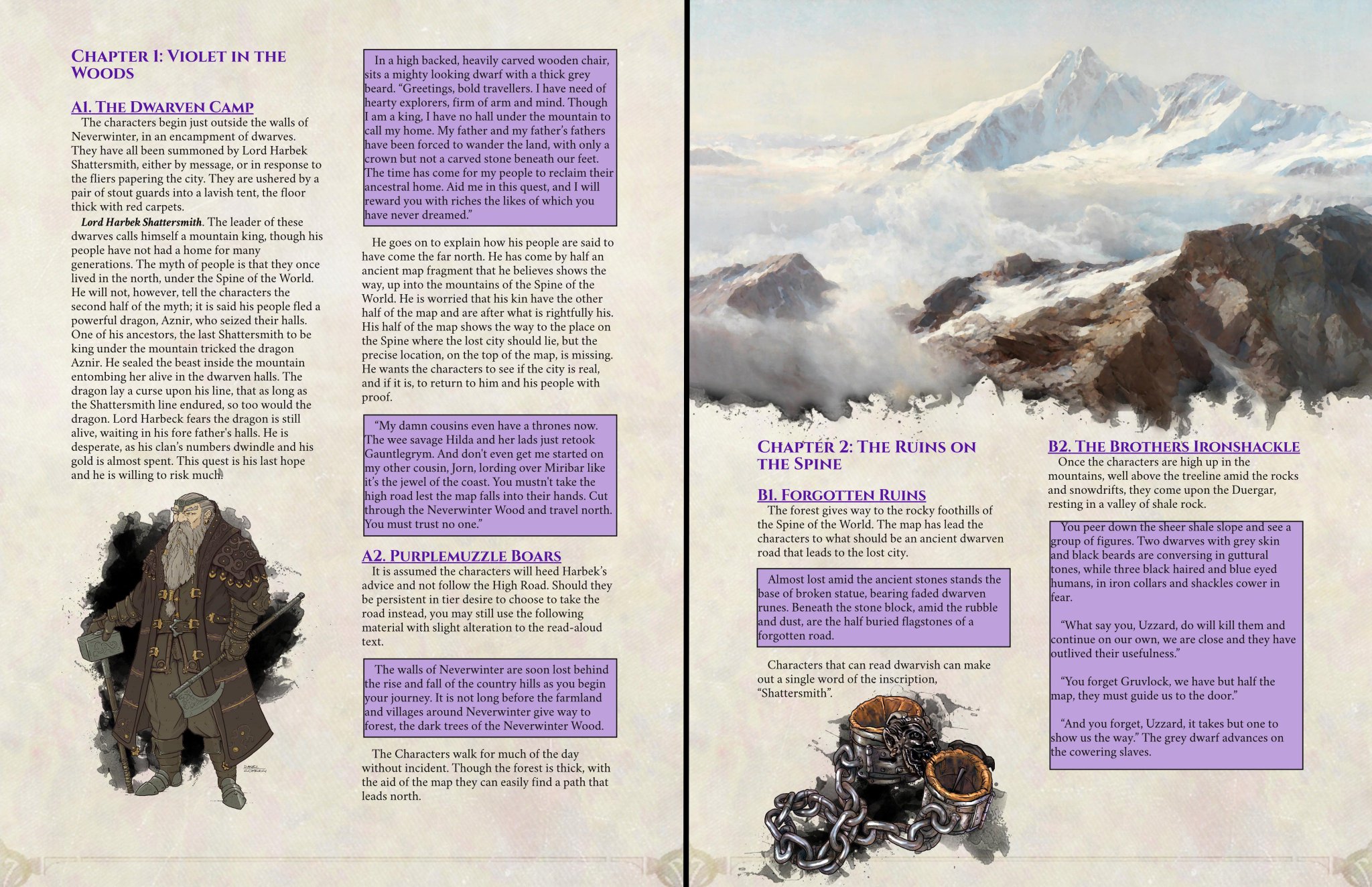
D&D 5e: The Value of Boxed Text

Boxed Text (or read-alouds) is one of those widely debated and highly contested pieces of D&D adventures.

If you're totally unfamiliar, boxed text is a bit of narration that is generally tagged or keyed to an encounter area in an adventure. Most published adventures for the last few editions of the game have made copious use of them; the players I work with (and I) are so trained to look for them that when an encounter area doesn't have boxed text, we tend to think the area is not a "real area" or at the very least it's unimportant.

While I understand the issues associated with boxed text, which I'll review shortly, it fills a necessary niche in the module. In very real terms, it's one of the main reasons I buy and run published adventures.

To the blessings:
  1. Boxed text cuts down on prep time. There. I said it. The number one reason I will always choose modules with boxed text over modules without is that it reduces the amount of work I have to do on the fly at the table. 
  2. Boxed text reminds players that they're participating in a cooperative story. In between the inside jokes, quips about Mt. Dew and Cheetos, and the inevitable mechanical foul-ups that bureaucratize the experience of Dungeons and Dragons, boxed text re-centers the players (and the DM) on the story at hand. 
  3. Boxed text allows the DM to worry more about the encounter than what the encounter looks like. If the players don't notice a key detail in read-aloud text, it can be repeated. If the DM has to make up an appropriate description on the spot, two problems arise: first, the DM may miss a crucial detail ("Oh, wait, the suits of armor are headless?") and second, the DM may end up contradicting their own descriptions on subsequent re-tellings ("I thought you said Jurime was a drow? That's the whole reason I wanted to hide!"). 
Admittedly, boxed text is not perfect--but it can get pretty close. Many more experienced writers and DMs than myself have tackled this question before.

  1. Shawn Merwin: In a 2010 article called "Thinking Outside the Boxed Text," Merwin poses a scenario in which players' characters are tossed out of the narrative because the boxed text gets details about their game world experience wrong. His solution is an appropriate one: shift the focus away from "you" when writing boxed text; the 2nd person is a bit too specific to apply well across characters. Merwin's advice continues by saying to keep boxed text reasonably short, direct, and clear--something that all effective module writing should be.
  2. Courtney Campbell: In a 2013 article called "On the Definitive Inadequacy of Boxed Text," Campbell makes the case that boxed text causes more problems than it solves. His main contention seems to be that boxed text reads like fiction, that human beings struggle to use the particular kind of focus that boxed text requires for longer than a few seconds, and that therefore almost anything would be a better alternative to boxed text. The one "solution" proposed is to have the text that is written for the DM's own eyes to be slightly more evocative (only slightly!) and therefore to have the DM's information occasionally spill over into what the players hear. This emphasis increases prep time, removes the narrative element in favor of a focus on mechanics, and doesn't solve the problem of burying important details.
The bottom line is that boxed text should never have to be read aloud. It can be read verbatim, it can be paraphrased, or it can be ignored. However, it should always be there for published adventures. It cuts down on prep time, it engages the narrative sense of the players, and it makes the DM's job at the table easier by ensuring that all relevant ideas are conveyed effectively to players at the start of an encounter or area. They can absolutely be done badly, but the existence of bad read-alouds is no excuse for throwing out the baby with the bathwater.

Sunday, September 24, 2017

D&D 5e: Initial Thoughts on High Level Adventuring

Now that my players have finished both ruining the Dragon Queen's day and sending the demon lords of the Abyss packing, they (and I) have been clamoring for some truly high level content. Both Tyranny of Dragons and Out of the Abyss were tremendous fun, and everyone enjoyed rising up to the heights of 15th level--but then the campaign is over, and in each case those really dazzling high level abilities remain both unattained and unused!

 I love running someone else's adventures; Wizards has done a great job with keeping new content fresh and interesting in ways that, if I were only running my own homebrew material, I would probably not attempt. Unfortunately for us, not only has Wizards' retained the policy that none of their published hardcover adventures will take characters past level 15, they've actually tightened it, moving the hardcover expectation down as low as 11!

I guess my group must be atypical? The newest member of our gaming circle has still been with us since the beginning of 5th edition, and everyone else has been around at least thirteen years (though we didn't start playing regularly until 5th edition and now we use the technological distance-closer of Roll20, which I can't recommend highly enough).

Regardless, I had a few options for how to challenge the group with a high level campaign.
  1. Homebrew: This is appealing in that the few homebrew dungeons/encounters I've slipped into our campaigns have either gone unnoticed (because they were seamless with the existing campaign) or been lauded (in the instances where I directly solicited feedback, as with The Vault of Eternity). Unfortunately, I've never run a high level campaign before. Not for 5th, not for 4th, not even for 3rd edition D&D. I would have loved to, but until now I've never had the chance. As a result, I feel a bit wary with how to appropriately challenge high-level PCs without simply making a series of boss-fights strung together by some roleplaying. 
  2. Dungeon Masters Guild: Perhaps surprisingly, there aren't many content creators who have tackled the high level adventure. The DMs' Guild's "Hottest Community 4th Tier (Levels 17+)" is a jumbled mix of a few Adventurers League adventures with a host of encounter packs, one-shots designed for pre-generated characters, and some admittedly noble attempts at post-20 (epic-level) game design.Unfortunately, many of these products are poorly presented and/or poorly edited. The ones that have some professional production values are often designed to be short and sandwiched in as a one-off. The few that seem to be legitimately designed as a real adventure module are either strangely formatted or don't provide a preview. (I will give a particular nod to The Palace of the Red Pasha for explicitly trying to fill this niche, but the formatting in the preview didn't sell me on the product.)
  3. Conversion from Older Editions: While there aren't many reputable high-level products available for D&D's fifth edition, there certainly are many for previous editions. Fourth edition is a bit of a pain to convert, and I have comparatively little experience with it, but thankfully third edition (3.0, 3.5, and Pathfinder) is swarming with adventure modules that live in the higher echelons of play. Ultimately, this is what I decided to go with for my players' high level campaign. I went back into my own stacks of old modules that I never got a chance to run and decided to modify and update rather than create from whole cloth.
I've run the first session (and a session zero) for this new high level campaign, and I've just about finished my conversion, adjustment, and update of the content I plan to use to get them all the way to level 20. To do this right, I wanted to make sure that I did three things:

  1. Stay true to the two campaign arcs which are converging (one character from Out of the Abyss is joining three characters who ran through Lost Mines and Tyranny of Dragons.) This means making sure that drow are keeping an eye out for demon lords, that some of those demon lords may want revenge, that Tiamat may be seeking another route to the material plane, or that someone may be seeking to undermine the success of the Phandelver/Phandalin mines. 
  2. Stay true to the characters themselves. This means finding those ways to incorporate those awesome ongoing backstories from two campaigns to make these characters the stars of a campaign that, on paper, never heard of them! 
  3. Stay true to the original intent(s) of the module. Especially since I haven't run a high level campaign before, I think it's prudent to try to keep the same emotional and structural components in my conversion (even if I don't 100% agree with or understand why the designers included what they did). 
The first and second things are largely second nature at this point; one of the best parts of DMing a long-running home-style campaign is that you get to know your players intimately and generally know what they value (and what they don't) in a session or about their characters. The third thing is a bit trickier, but I've tried to stick with it.

For example, in the first session, the characters don't have too many ideas about "what's going on" (something I hate; I love it when PCs know right from the get-go what the big bad hunting them/trying to end the world is going to be). They've used their high level divinations and contacts and these led them to plane shift to the Outlands to look for more clues. While there, the PCs are expected to track down an efreeti merchant; the original module is a bit fuzzy on how they get the relevant information to even find him, but I managed to make it seem like a priority to find him and talk to him. It was a simple roleplaying encounter which lasted all of ten minutes in real time (probably less), and I had considered glossing it--giving the information the efreeti provided through a divination spell or from one of the PCs contacts--but by roleplaying him as an upset merchant (as the script called for), the PCs believed him. Perhaps more importantly, they felt like they'd earned the information and took it to heart. What had been a meandering, purposeless quest suddenly became a single-minded directive: "we're going where he suggested."

I would have missed that.

The only other item worth mentioning is that since we are using Roll20, we had to import character sheets from two separate campaigns who had been running two separate character sheets. That turned out to be a bit of a blessing in disguise since it meant all of the players had to re-read everything on their character sheets to make sure nothing was imported incorrectly or missing. As a result everyone came to the table with a greatly refreshed understanding of what they could do. To remind the players of how cool their party was, I had them start off session 1 by telling the other players the "coolest" thing their character could do. It was a simple five minute exercise, but it was a worthy reminder to them (and to me) of what challenges they could overcome!

Ultimately, I'm not entirely sure the third edition "feel" will mesh entirely with the fifth's atmosphere, but we're going to find out.
Friday, July 14, 2017

D&D 5e: The Vault of Eternity


“The Vault of Eternity” is my latest project. Because this deals with the problems (and successes!) of running Out of the Abyss, please be aware that here there be spoilers. For those of you who’ve DM’d for the Rage of Demons story arc (and specifically for Out of the Abyss), one of the most common complaints I’ve seen is with the random encounters; no one seems happy with them, though the problems are wide-ranging and sometimes contradictory.(By the way, this is not intended to be a critique of Out of the Abyss, but just an expression of what was being juggled in my head as I sought to fill this particular gap!)

Among the problems players and DMs have mentioned:
1.      Too much bookkeeping:
If you follow the prescribed random tables exactly, you end up with the possibility of something like 160 encounters while traveling between places in the Underdark. Even if 75% of these are non-combat, that’s still a significant amount of dice rolling, stat tracking, and game time.
2.      Not enough variety:
After rolling on these same tables since level 1, the party will be fighting the same random encounters at level 10. This seems monstrously monotonous (regardless of any balance issues).
3.      Too many NPCs:
The Expeditionary Force the PCs lead back into the Underdark has very little functionality except as cannon-fodder and the creation of a second set of encounter tables. Without a set of mob-vs-mob rules, it becomes cumbersome at best to run these as written.
There are many, many bloggers and posters who have addressed these issues with novel
and often innovative solutions to the above issues, and I won’t attempt to summarize their findings here. The main point is that all of these problems become nearly insurmountable at a very specific point in the adventure: when the party is on their way to the library of Gravenhollow.


Though the module’s organization is a bit wonky as to where the information appears, there is a clear directive that PCs should be tenth level before they arrive at Gravenhollow. Even with an abundance of experience-yielding encounters and a few milestone level-ups, my players were only approaching ninth level when they were ready to start looking for the library. My players had already dealt with the major problems of each of the Underdark settlements that they were aware of (except Menzoberranzan, which they’ve been heavily disincentivized away from because of their party composition and backgrounds). They had beaten mini-bosses and fought through almost all of the random encounters at least once, and yet they were nowhere near where they needed to be, power-wise, to tackle the next leg of the campaign.
This is where the Vault comes in.


I needed the PCs to have a legitimate break from “The Demon Lords are everywhere!” without having a  completely unconnected side-quest. After all, the urgency of the campaign is part of its charm. Personally, I think that a few surface quests—included in Out of the Abyss—would have potentially filled this void. Unfortunately, my party consists almost entirely of Underdark races who have few ties to the surface, and after “escaping the Underdark” they were mostly adrift—they needed an excuse to return to it.
So what does “The Vault of Eternity” do?
1.      It provides an even more urgent reason to engage it than the main campaign does: a few friends are kidnapped after an earthquake; an investigation separates the party from their other friends but offers them an opportunity to pursue their friends’ kidnappers).
2.      It has the flavor of the Rage of Demons storyline: there are demons and cultists loose in the dungeon the PCs find themselves in. They’re connected to Orcus (and therefore, it feels like another in a long line of demon-lord-led-groups just as the PCs have found in each major settlement along the way).
3.      It is a traditional dungeon crawl: forty-some chambers, each self-contained, offers a traditional dungeon exploration experience within the sandbox of Out of the Abyss.
4.      It offers treasure and twists: a plethora of unique—named—magic items can be found throughout the complex, and there’s an underlying mystery (with weird, never-before-seen twists on traditional creatures) tying everything together. Discovering loot while unraveling the mystery is a delight for players—unlike so much of the campaign, this mystery is entirely solved by the time they leave the dungeon (without many lingering concerns). 

My players loved it, and I hope yours will too. Please feel free to give me some feedback; this is my first time putting together an adventure for sale, and while I did my best to make it as professional and polished as possible, I understand that there are always ways to improve!

Here’s the link to this adventure on the Dungeon Master’s Guild.

Sunday, May 8, 2016

D&D 5e: The Artificer Class, Unveiled!

For the last many months, I've been working on how to create an Artificer class which would work under the D&D 5e rule set. With the advent of the new SRD, I was able to justify spending the additional time to attempt to polish and eventually publish my ideas.

As such, I'm happy to unveil the Artifice class for 5e on the DMs Guild website. You can download your copy for free (or you can chip in a donation if you feel like it).

Here's the link: Artificer Class

If you're coming to this site for the first time and you're interested in some of my thought process on how the class was developed, you can check them out here on the blog. Roughly, the development followed these steps:
  1. The Overview of the Problem
  2. Permanent Item Creation
  3. Infusions and Class Features
  4. Archetypes and Finishing Touches 
Of course, even after the fourth blog post, I worked for another few months (on and off) to refine the design. Ultimately, it needs some play-testing from new eyes to really get any remaining kinks out!

Please feel free to drop some commentary in the comments; I'm looking forward to updating this little labor of love.

In the meantime, if you do give it a quick read-through, don't forget to rate it!