Showing posts with label 5e. Show all posts

Saturday, December 28, 2019

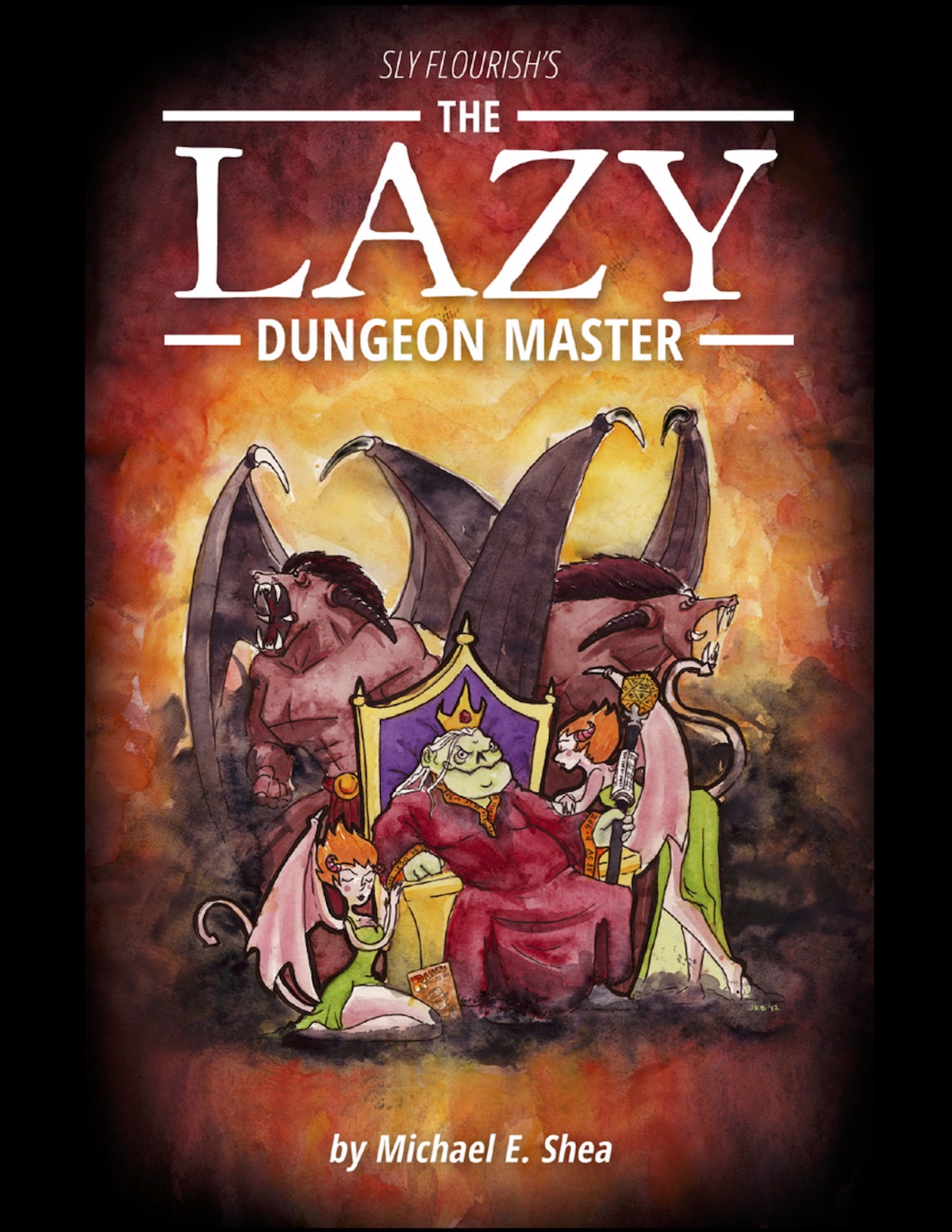
D&D 5e: Sly Flourish's The Lazy Dungeon Master

If you've stumbled onto this post, chances are you already know about Sly Flourish: a deeply data-driven game master who has thought extensively and deeply about the ways DMs run their games (and, perhaps more importantly, how games can be run better!).

I've followed Sly Flourish's Twitter for a little more than five years--since roughly the start of the hype for D&D Next/5e. Until this week, I haven't had a chance to actually look at the physical, published work of Mike Shea (the person behind the Sly Flourish "brand"). My wife bought me a copy of the original Lazy Dungeon Master and in between holiday festivities I've happily read through it, using my read-through as a perfect opportunity to test out note-taking in my other Christmas gift, a Rocketbook.

This post, then, does two things: it serves as a look back at what DMing advice looked like before D&D's fifth edition, and it serves as a rough "review" of Shea's original text on the subject.

On page 7, Shea posits the central idea of his project: "Think back over...the most memorable moments...How many were pre-scripted by the DM and how many were memorable simply because no one...had any idea what was about to happen[?]"

Honestly? Almost always, the best moments I've seen while DMing (or as a player) were judiciously prepared ahead of time; a critical choice or even roll is the focus--an inexchangeable  contribution by players--but that moment itself is well-prepared far in advance.

I agree with Shea that the story is build "while the game runs at the table," but, for my players at least, the direction of that story is often set in motion ahead of time.

On page 8, Shea proposes that DMs should "keep [the] choices down to three."

This is solid advice in almost every arena of player interaction. Fewer than three choices can feel scripted. (It must be either this or that!) More than three can feel overwhelming very quickly. Even in the most advanced open-world games, if we're completely directionless the games often become merely playgrounds. Think of the difference  between playing Minecraft and playing Skyrim: Both could be satisfying, but only the second is a roleplaying game.

Shea walks DMs through the process with a sample adventure scheme and asks DMs to create their
own as he unveils the process. One of his first questions is, "Where does your adventure begin?" This is good advice in the pre-5e world. If we're truly doing the start of a campaign, I might replace that now with, "How do the PCs know each other? Why are they together?" I followed the advice and attempted to generate three areas the PCs might encounter/explore, three notable NPCs, and 3 villainous NPCs. I have gone through exercises like this before, and while I find them helpful in theory, I seldom end up using anything I generate in actual play. Perhaps ironically, I find that the time I spend on such exercises is wasted (for me). I hope it actually stretches my creative muscles, but I have no evidence to suggest that it does. 

On page 15, Shea recommends "Don't sell an ending you can't deliver." Put another way, he recommends letting players drive the story. This is sound advice for a group of "active" players! Most of the players I deal with are in the "lazy" category. They are explorers, traveling through the game world like tourists. They want to see, they want to experience, and they want to solve puzzles (in addition to clobbering monsters and becoming more powerful). Put another way, they're not looking for adventure, they're looking for adventure to find them! If there's no world-ending threat, their experience is somehow diminished. It's not to say that an occasional side-quest or silly session can't be rewarding--they are!--but rather that the reason my players play is both to spend time with other/have fun and to be heroes. Shea is right that we shouldn't sell endings we can't deliver, but I'd rather look at this as: "Don't forget to deliver on the ending you've sold!" I don't want to play in a campaign without the ending I "bought." 

On page 26, Shea writes his sixteenth section on "Reskinning". It's solid advice. Never re-create what you can just re-skin! Flavor is easy to change; mechanical calibrations take a lot of time and the chances are that someone has already done it for you. On page 28, Shea (crediting Dave Chalker) introduces the term "Combat Outs" to describe methods a DM might use to end a combat early. I love the term and I'm surprised I didn't come across it sooner. In the same section, Shea talks about how maybe we over-prepare the mechanics of monster strongholds and posits that we could probably get by with the knowledge that there is a stronghold and that it has X number of creatures guarding it. As a DM, I need a LOT more guidance to work with ahead of time than how many monsters there are. How big is the complex? How many of the creatures guard the doors? Are sleeping? Are fighting? What are the rest doing? Eating? Slaving? Gambling? Without that info in advance, I'm likely to treat them as mindless traps, coming to life when the PCs are present in empty, faceless rooms and becoming inert and inactive otherwise. 

Pages 29-30 are the most dated in the book. Credit to Shea, though, as he foreshadows both the way 5e deals with experience (milestones) and ascending power bonuses (proficiency). His "PC Wish List" has a charm to it, but takes a lot of the fun out of random loot. What I've done in the past is to ask PCs to choose/make a single magic item for their character that I, as DM, will supply as a reward or piece of loot at some point in the campaign. That way, PCs get the opportunity to be a part of a reward system without taking away the majority of the fun of random loot! 

On pages 31-32, Shea offers his critique of using published materials. His objections revolve around the time costs of preparing them and the "generic" nature of them. He's right about both. I suspect the generic nature is one of the reasons published campaigns so seldom write their way through the upper teens to make characters level 20 (and simultaneously, why so many campaigns don't make it to the upper teens). Regarding that preparation, I find it useful time spent because any moment spent preparing for a published campaign is guaranteed effective; it points somewhere! The story/arc are present, the clues/foreshadowing are already figured out, all that has to be done is to drop players in and let them play. Preparing or running a homebrew (or "lazy") game may end in a dead-end. Published campaigns don't. It requires "active" players to maintain the momentum of a "lazy" campaign; I don't sustain that as a player, and I think it might be a tough sell for my own players! As far as the "generic" part, that's where using them "loosely" as "inspiration, not gospel" comes in and makes sense. Running published adventures can't be done slavishly in the best of conditions, but it needs to be done artfully to be done well. 
On page 33, Shea writes that we should "delegate to the most distracted" player(s), and this is excellent advice at any game table. Give players responsibilities that are simple but recurring. On page 34, Shea skates the surface of what "Lazy Dungeon Mastering" is all about: Improving Improvisation. Improv is a very important skill; in the home games I've been a part of, however, solving the "big mystery" that defines the campaign is one of the main reasons we enjoy it together! Improv for NPCs, voices, side-quests--that's all exceptionally good and useful. On the other hand, improvising the campaign from a single seed is...too undeveloped for me. If that mystery isn't there to unravel, it doesn't matter what the "trust" situation" is like. Having said that, most of the section contains great advice: practice, practice, practice, and ultimately aim for relaxed awareness at the table. 

The last section of the book involves transcriptions of his interviews with ten notable DMs. I think this section was the most shocking in that the DMs overwhelmingly (eight out of ten!) were in favor of a lot of preparation before their games.

What all ten seemed to agree on:
  1. DMs are not novelists or lore developers: don't waste time on extraneous lore or world-building. Let all of that flow naturally. 
  2. Mechanical effects are important when designing set-piece encounters, but almost none of the DMs mentioned monster or NPC stat creation. Their time was spent on the personality or motives of NPCs/monsters. Stats come from the manuals.
  3. The best sessions blossom when PCs respond to the DM and the DM responds to the players. 
Conclusion: Preparation (of the right kinds) is extremely important.
 
Overall, I'm glad I read it, but in retrospect, I should probably have read Return of the Lazy Dungeon Master instead!

One side note that bothered me as a teacher of English is the number of typos. Shea does need to hire an editor for future projects!

Monday, March 18, 2019

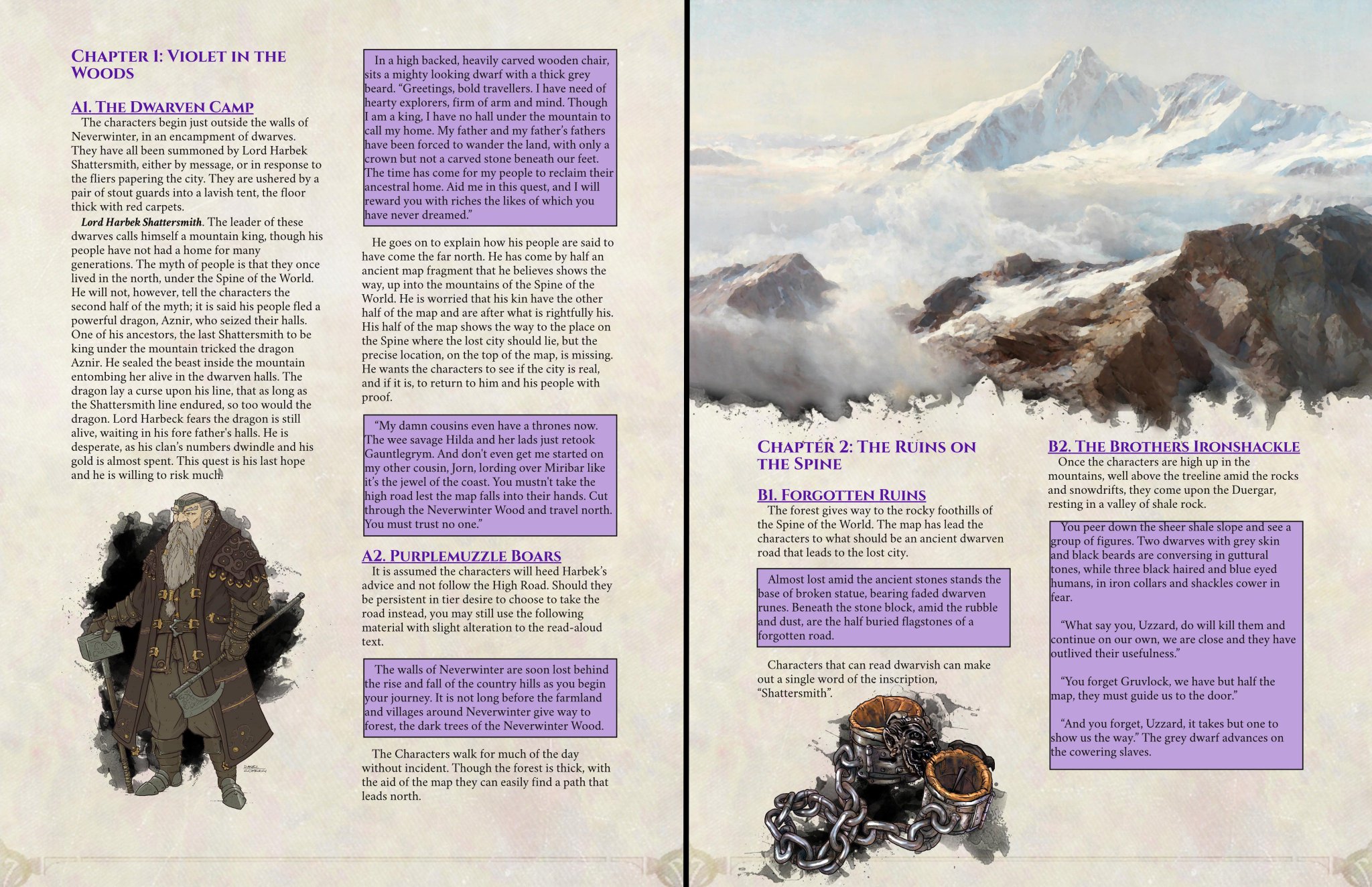
D&D 5e: The Value of Boxed Text

Boxed Text (or read-alouds) is one of those widely debated and highly contested pieces of D&D adventures.

If you're totally unfamiliar, boxed text is a bit of narration that is generally tagged or keyed to an encounter area in an adventure. Most published adventures for the last few editions of the game have made copious use of them; the players I work with (and I) are so trained to look for them that when an encounter area doesn't have boxed text, we tend to think the area is not a "real area" or at the very least it's unimportant.

While I understand the issues associated with boxed text, which I'll review shortly, it fills a necessary niche in the module. In very real terms, it's one of the main reasons I buy and run published adventures.

To the blessings:
  1. Boxed text cuts down on prep time. There. I said it. The number one reason I will always choose modules with boxed text over modules without is that it reduces the amount of work I have to do on the fly at the table. 
  2. Boxed text reminds players that they're participating in a cooperative story. In between the inside jokes, quips about Mt. Dew and Cheetos, and the inevitable mechanical foul-ups that bureaucratize the experience of Dungeons and Dragons, boxed text re-centers the players (and the DM) on the story at hand. 
  3. Boxed text allows the DM to worry more about the encounter than what the encounter looks like. If the players don't notice a key detail in read-aloud text, it can be repeated. If the DM has to make up an appropriate description on the spot, two problems arise: first, the DM may miss a crucial detail ("Oh, wait, the suits of armor are headless?") and second, the DM may end up contradicting their own descriptions on subsequent re-tellings ("I thought you said Jurime was a drow? That's the whole reason I wanted to hide!"). 
Admittedly, boxed text is not perfect--but it can get pretty close. Many more experienced writers and DMs than myself have tackled this question before.

  1. Shawn Merwin: In a 2010 article called "Thinking Outside the Boxed Text," Merwin poses a scenario in which players' characters are tossed out of the narrative because the boxed text gets details about their game world experience wrong. His solution is an appropriate one: shift the focus away from "you" when writing boxed text; the 2nd person is a bit too specific to apply well across characters. Merwin's advice continues by saying to keep boxed text reasonably short, direct, and clear--something that all effective module writing should be.
  2. Courtney Campbell: In a 2013 article called "On the Definitive Inadequacy of Boxed Text," Campbell makes the case that boxed text causes more problems than it solves. His main contention seems to be that boxed text reads like fiction, that human beings struggle to use the particular kind of focus that boxed text requires for longer than a few seconds, and that therefore almost anything would be a better alternative to boxed text. The one "solution" proposed is to have the text that is written for the DM's own eyes to be slightly more evocative (only slightly!) and therefore to have the DM's information occasionally spill over into what the players hear. This emphasis increases prep time, removes the narrative element in favor of a focus on mechanics, and doesn't solve the problem of burying important details.
The bottom line is that boxed text should never have to be read aloud. It can be read verbatim, it can be paraphrased, or it can be ignored. However, it should always be there for published adventures. It cuts down on prep time, it engages the narrative sense of the players, and it makes the DM's job at the table easier by ensuring that all relevant ideas are conveyed effectively to players at the start of an encounter or area. They can absolutely be done badly, but the existence of bad read-alouds is no excuse for throwing out the baby with the bathwater.

Saturday, March 17, 2018

D&D 5e: Final Thoughts on High Level Adventuring

Whew! Level 20 and beyond.

In the out-of-context words of Jerry Seinfeld, "They did it! It's done. We have it now."

If you haven't seen my thoughts on the start of this high level campaign and wanted to start at the beginning you may want to check out my initial thoughts and my continued thoughts before reading on.

When I set out, I wanted to tackle the challenge of a running my first high level campaign by achieving the three goals of synergy (bringing together Out of the Abyss and Tyranny of Dragons), character (continuing to let my players' character develop and grow beyond being just murder-hobos), and consistency (staying true to the intention/mood of the modules I was adapting).  

PAST THIS POINT, THERE WILL BE SPOILERS FOR BOTH OUT OF THE ABYSS AND TYRANNY OF DRAGONS. You've been warned!
  1. Synergy: The modules I chose were well-suited to the task at hand; each one was thematically including dragons and demons without me having to change a thing. By upgrading the draconic threat to a vengeful Tiamat and by shifting some motivations for Demogorgon as a demon lord, this went smoothly through all five-to-six levels (15-20).
  2. Character: This was, perhaps, a weak point. My players and I have all grown somewhat lax in the roleplaying department, and there are so many abilities on high level characters' sheets, and  so many intersections between them and the campaign world that it became a chore to keep them all developing at the same rate they did all the way back in levels 1-4. On the flip side, I was able to include a wide range of NPCs from their past. For example, at one point the party infiltrated a fiendish forge on a floating cube on the plane of Acheron. There, they discovered the enslaved souls of many dwarves and forgemasters they had met, lost, or even killed over the course of their adventures! Here was the cleric's cousin who didn't accept a resurrection; here was the near-immortal and ancient forgemaster who died after you helped him destroy an ancient evil; here was a legendary armor-smith whose work was so well-known he was believed a myth more than a man! These tie-ins let my players know that all of their exploits were going somewhere, and that their actions had lasting ramifications throughout Faerun. 
  3. Consistency: This was the one I worried about the most. Conversion became harder and harder the more esoteric and high-level the enemies became. Third edition terms like "power-up suite" and "monster template" have little-to-no meaning in fifth edition, and the current Monster Manual is a bit light on the flavorful high level threats that plagued third edition's adventuring parties. As such, I had my work cut out for me finding and re-skinning existing monsters to fit the flavor of the modules. Some spells and abilities just flat-out don't exist in fifth edition, and a lot of the fights--particularly in the final dungeon--needed to be reworked entirely to make sense. Doing all of this without a proper understanding of what a party of third-and-fourth-tier fifth-edition heroes can do or survive or be challenged by involved a lot of intuition and a fair amount of math. In the end, I think I mostly guessed well. There were a few fights I felt I could have made more challenging and a few that I thought were too easy, but on the whole it evened out.
 As we moved through those first levels past 15, I realized that some things were very, very different at high levels of play. In my last blog post, I considered travel, rest, combat resolution variability ("swingy-ness"), and uncertainty.

  1. Travel: It's shocking how quickly interplanar and teleport-based travel becomes the new normal. The only time "wandering monsters" or "travel encounters" are even a possibility is within a high-level dungeon--somewhere that clamps down on divinations and magical transportation spells. For example, as the PCs approached the final boss fight of the campaign, they stumbled onto some gigantic soul-sucking manta-ray-like extra-planar creatures. The warlock, sensing the danger she was in, cast blink. This has become common--and usually wise--practice from this character. In this case? The location of the dungeon was so exotic that there was no connection to the ethereal plane. Just like that, our warlock had wasted a turn in combat trying to escape without any effect. The greater the danger and the stranger the dungeon, the more high-level magical restrictions tamp down on the ability of the PCs to use their crazy abilities to circumvent dangers or succeed too easily.
  2. Rest: My--and others'--thoughts on how short and long rests should be meaningful takes on a whole new meaning when PCs can often take shelter in invincible or inaccessible portable places (or even palaces).  My earlier intuition was correct. To make encounters meaningful, they either had to be so overwhelmingly strong as to challenge a party at full strength or else they had to be encountered in such a place or at such a time that it would be unwise or even impossible to retreat to a safe place afterward. The general was to accomplish this was with a time crunch: the longer the PCs delay, the stronger the bad guy gets or the more likely the PCs will be too late to stop the bad guy. Occasionally, creating a location that rewards going forward but punishes going back can be similarly challenging. I tried to employ both of these methods to keep things interesting for the party. 
  3. Variability: I confess. Life domain clerics are, to use the old-school vernacular, "broken." The idea that a standard high level cleric character can pop a heal spell in an action that grants seven hundred hit points in an area effect heal is incredible. When you add onto that a cleric whose every heal spell does maximum healing, you're talking about a character who--as long as he's conscious--makes everyone else immortal for as long as he has spell slots. My PCs used every trick in the book and pulled out all the stops for the final fight--drinking potion cocktails, using concentration-buffs, and having expendable magic items at the ready--but I'm convinced that having a life domain cleric would have rendered the final fight less dangerous regardless. Looking back, the raw damage output from the final boss may have been too much for any other healer to keep up with! It certainly would have required a lot more cleverness and possibly even sacrifices from the PCs. In the end, the variability factor played a big role, but that role could have been much bigger without the party cleric!
  4. Uncertainty: As I alluded to when discussing travel, I was shocked at how quickly high-level spells and abilities became the new normal (and our warlock's player would probably tell you how they never get tired of exploding bad guys' heads). Though there was still some tentativeness as the players felt out the extent of their abilities, as it became clear just how powerful they really were, they took to it like fish to water. Divine intervention? Sure! God can help us with this. Holy nimbus? That'll look nice when were crushing a dragon goddess! Stroke of luck? Use it early and "often" to achieve maximum criticals--especially when assassinating a mid-level enemy healer who had no idea she was going to die in one hit! And what's scarier than a warlock at level 20? An Eldritch Master who has twice as many spell slots
Overall, it was a really exciting ride. My players and I had a great time; I have no qualms about recommending this path to groups who finish a published adventure and want to go farther!

In fact, now that we've done it, I really don't understand Wizards' decision to not have at least one campaign that addresses these higher levels. I believe that a campaign written for, say, levels 11-20 or even 15-20 would be a rousing success! Maybe someday they'll give it a go. For now, we'll just have to rely on the Dungeon Masters' Guild to fill the void.

In the wake of this, I've been working on my own homebrew campaign (one teaser of which is already up on the Dungeon Masters' Guild). I haven't run a full homebrew in almost 10 years; as I attempt to bring back that style of DMing, I'll also be attempting to polish my personal notes into something that others can use. The success of The Vault of Eternity (at the time of this writing, it's hit silver!) has taught me that others value what I'm working on at least enough to put it out there.

Until next time, happy gaming!

Saturday, January 20, 2018

D&D 5e: Continued Thoughts on High Level Adventuring

What a weird ride! My players have now conquered the first half of their post-15 campaign (i.e. they've completed one of the two modules I updated). (For my initial thoughts, check out the first post in this series.)

There are some very sharp contrasts between running adventures below 15th, and running adventures after 15th. Here are a few of the things I've noticed:
  1. Travel is completely different. When PCs have daily or routine access to teleportation items, plane shift, and eventually gate, travel is no longer an issue. (For example, even if you don't have access to a teleport spell, two plane shifts or two gates can serve the same function! Yes, it takes two higher level spell slots, but these PCs have those slots!) This changes how PCs conceive of an adventure--and certainly how the DM needs to. No longer is distance in any way related to the number of encounters or the time it takes to journey; characters looking at going from their mountain stronghold into a nearby city and characters looking to travel from that same stronghold to a city on a different continent are likely to consider exactly the same magical--and instant--forms of travel to get there. Even if the characters don't know where they want to go, they have access to a whole bevy of new spells (and/or items and/or NPC contacts) who do know: legend lore, scrying, commune, contact other plane, divination, find the path--each offers another window into the unknown, and having access to a combination of them solves a lot of riddles and mysteries without ever leaving home! The end result is that even if they didn't know where they needed a to go, one hint or clue can lead them to the right place to begin their investigations in earnest within perhaps an hour of game-world time. Gone are the early adventuring days where a single clue would form the basis of a month's adventure to a distant hermit to find an answer to a long-forgotten problem.
  2. Rests are completely different. This is somewhat a corollary to the ideas on travel: because PCs are so incredibly mobile, there are very few times when the right move is not to simply retreat to their magically fortified (and possibly well-staffed) home base whenever they need to rest and recharge. Even if going all the way home is not an option, the PCs may have access to spells or items which are even better than going home. Mordenkainen's Magnificent Mansion (level 8) presents an opulent version of a home away from home, but even a Leomund's Tiny Hut (level 3) can get the job done, offering PCs time to rest and recharge for either a short or a long rest. In addition to the travel changes removing a lot of the "random encounters" on the road, the rest protection options remove many of the dangers of "taking a rest." Only time remains to consistently work against these high level PCs!
  3. Fights are extremely swingy. High level monsters hit often and they hit hard. High level PCs
    do the same. Similar to the first few levels of adventuring, it becomes really important that the party tanks (or those with high hp) are taking the hits, while the squishier members of the party are free to control the field or deal damage. Spells that cause an opponent to lose an action or which limit the kind of actions they can take become useful (in my opinion) for the first time. Causing a goblin boss in a low level fight to sacrifice an action is no big deal; an action may have done some damage, but realistically he probably has surrounded himself with a horde of lower level goblins who can deal almost as much damage in a round! On the other hand, causing a dragon, an eight-armed sword-fighter, a high level warlord, or a wizard with 9th level spells to lose an action is tremendous. Each one can do a tremendous amount of damage (or exert a lot of control) in a single round, and forcing a delay tilts the action economy into the hands of the PCs rather nicely. PCs at this level are even more resilient than I had first believed they would be; even when fighting a variety of opponents--each of whom, on their own, would be a worthy challenge for the PCs--the wide range of abilities and synergies the party has access to made them incredibly powerful. The big boss fight at the end of the adventure was spectacular, but when the dust settled, the PCs could probably have done another fight of equal caliber and survived. Then again, it's possible that the PCs could have made one poor choice and the whole fight would have become a rout.
  4. Even experienced players (and DMs) feel uncertainty. A D&D player from any edition knows what to do when they encounter magic missile, cure light wounds, a locked door, or a new +1 longsword. They've seen all of this before in a dozen, even a hundred iterations. But how many times have players had access to wish? When you're dealing with entirely virgin territory, it's natural for all people involved to feel a bit uncertain. This is both the fun and the terror of the high level campaign. All of my players made some amazing choices and did some epic, heroic feats over the course of the adventure. One that sticks in my mind is when our cleric prayed to his god (Moradin) for intercession to resist the heat of the unholy furnace the party was headed into. Because his character is such a high level, the odds were significantly better than they would have been normally, and a good roll meant that Moradin granted the prayer! The fire resistance the party picked up was (in my opinion) the difference between an easy boss fight and a potentially deadly one. Without a wizard, this party managed to magically solve a problem they didn't legitimately have a spell or a magic item for. That is high level adventuring at its finest.
As this party of characters moves into what will likely be their final adventure together, they're all
level 18. Those high level abilities most players only dream about their characters having are a reality--or just one or two short levels away. For me, it's going to be a challenge to challenge them. High level encounters each have to be set pieces; no more random bandits or wandering monsters, no more minor problems or careless issues. For these characters to be involved, the threat to the world has to be real, imminent, and disastrous!

And it is.

Stay tuned for more thoughts on high level adventuring as my players take their characters to the brink and maybe a bit beyond!

Sunday, September 24, 2017

D&D 5e: Initial Thoughts on High Level Adventuring

Now that my players have finished both ruining the Dragon Queen's day and sending the demon lords of the Abyss packing, they (and I) have been clamoring for some truly high level content. Both Tyranny of Dragons and Out of the Abyss were tremendous fun, and everyone enjoyed rising up to the heights of 15th level--but then the campaign is over, and in each case those really dazzling high level abilities remain both unattained and unused!

 I love running someone else's adventures; Wizards has done a great job with keeping new content fresh and interesting in ways that, if I were only running my own homebrew material, I would probably not attempt. Unfortunately for us, not only has Wizards' retained the policy that none of their published hardcover adventures will take characters past level 15, they've actually tightened it, moving the hardcover expectation down as low as 11!

I guess my group must be atypical? The newest member of our gaming circle has still been with us since the beginning of 5th edition, and everyone else has been around at least thirteen years (though we didn't start playing regularly until 5th edition and now we use the technological distance-closer of Roll20, which I can't recommend highly enough).

Regardless, I had a few options for how to challenge the group with a high level campaign.
  1. Homebrew: This is appealing in that the few homebrew dungeons/encounters I've slipped into our campaigns have either gone unnoticed (because they were seamless with the existing campaign) or been lauded (in the instances where I directly solicited feedback, as with The Vault of Eternity). Unfortunately, I've never run a high level campaign before. Not for 5th, not for 4th, not even for 3rd edition D&D. I would have loved to, but until now I've never had the chance. As a result, I feel a bit wary with how to appropriately challenge high-level PCs without simply making a series of boss-fights strung together by some roleplaying. 
  2. Dungeon Masters Guild: Perhaps surprisingly, there aren't many content creators who have tackled the high level adventure. The DMs' Guild's "Hottest Community 4th Tier (Levels 17+)" is a jumbled mix of a few Adventurers League adventures with a host of encounter packs, one-shots designed for pre-generated characters, and some admittedly noble attempts at post-20 (epic-level) game design.Unfortunately, many of these products are poorly presented and/or poorly edited. The ones that have some professional production values are often designed to be short and sandwiched in as a one-off. The few that seem to be legitimately designed as a real adventure module are either strangely formatted or don't provide a preview. (I will give a particular nod to The Palace of the Red Pasha for explicitly trying to fill this niche, but the formatting in the preview didn't sell me on the product.)
  3. Conversion from Older Editions: While there aren't many reputable high-level products available for D&D's fifth edition, there certainly are many for previous editions. Fourth edition is a bit of a pain to convert, and I have comparatively little experience with it, but thankfully third edition (3.0, 3.5, and Pathfinder) is swarming with adventure modules that live in the higher echelons of play. Ultimately, this is what I decided to go with for my players' high level campaign. I went back into my own stacks of old modules that I never got a chance to run and decided to modify and update rather than create from whole cloth.
I've run the first session (and a session zero) for this new high level campaign, and I've just about finished my conversion, adjustment, and update of the content I plan to use to get them all the way to level 20. To do this right, I wanted to make sure that I did three things:

  1. Stay true to the two campaign arcs which are converging (one character from Out of the Abyss is joining three characters who ran through Lost Mines and Tyranny of Dragons.) This means making sure that drow are keeping an eye out for demon lords, that some of those demon lords may want revenge, that Tiamat may be seeking another route to the material plane, or that someone may be seeking to undermine the success of the Phandelver/Phandalin mines. 
  2. Stay true to the characters themselves. This means finding those ways to incorporate those awesome ongoing backstories from two campaigns to make these characters the stars of a campaign that, on paper, never heard of them! 
  3. Stay true to the original intent(s) of the module. Especially since I haven't run a high level campaign before, I think it's prudent to try to keep the same emotional and structural components in my conversion (even if I don't 100% agree with or understand why the designers included what they did). 
The first and second things are largely second nature at this point; one of the best parts of DMing a long-running home-style campaign is that you get to know your players intimately and generally know what they value (and what they don't) in a session or about their characters. The third thing is a bit trickier, but I've tried to stick with it.

For example, in the first session, the characters don't have too many ideas about "what's going on" (something I hate; I love it when PCs know right from the get-go what the big bad hunting them/trying to end the world is going to be). They've used their high level divinations and contacts and these led them to plane shift to the Outlands to look for more clues. While there, the PCs are expected to track down an efreeti merchant; the original module is a bit fuzzy on how they get the relevant information to even find him, but I managed to make it seem like a priority to find him and talk to him. It was a simple roleplaying encounter which lasted all of ten minutes in real time (probably less), and I had considered glossing it--giving the information the efreeti provided through a divination spell or from one of the PCs contacts--but by roleplaying him as an upset merchant (as the script called for), the PCs believed him. Perhaps more importantly, they felt like they'd earned the information and took it to heart. What had been a meandering, purposeless quest suddenly became a single-minded directive: "we're going where he suggested."

I would have missed that.

The only other item worth mentioning is that since we are using Roll20, we had to import character sheets from two separate campaigns who had been running two separate character sheets. That turned out to be a bit of a blessing in disguise since it meant all of the players had to re-read everything on their character sheets to make sure nothing was imported incorrectly or missing. As a result everyone came to the table with a greatly refreshed understanding of what they could do. To remind the players of how cool their party was, I had them start off session 1 by telling the other players the "coolest" thing their character could do. It was a simple five minute exercise, but it was a worthy reminder to them (and to me) of what challenges they could overcome!

Ultimately, I'm not entirely sure the third edition "feel" will mesh entirely with the fifth's atmosphere, but we're going to find out.

Sunday, August 27, 2017

D&D 5e: Out of the Abyss (Part 2 of 2)

Playing in a campaign while running a campaign (and alternating which campaign we play) definitely extended how many sessions--and thus how long--it took to play through the second half of Out of the Abyss.

By my reckoning, we've played through a total of 25 sessions, total, for Out of the Abyss. Each of those sessions ran for an average of three hours, meaning that the full book yielded roughly 75 hours of play time for players and probably another 120-150 hours of prep time to run it. On the whole, that's a pretty good deal even if you paid full price for the book--less than a dollar an hour for your entertainment.

As always, please be mindful that while I try to keep spoilers to a minimum, this discusses the end of 75 hours of game time and the epic conclusion of the campaign: 

HERE THERE BE SPOILERS. You have been warned.

As with the Tyranny of Dragons' storyline, and perhaps even more so, I get the feeling from the online D&D community that most groups don't finish the overarching campaigns they start. In fact, the Wizards team seems to have done research on this point, as Out of the Abyss is one of only three adventure modules that is designed explicitly beyond 11th level!

I'm going to refer back to what I liked and disliked about this module from my Part 1 post; feel free to check back if you need a refresher.

I have to admit, I had almost all of this post written by the time we reached the second-to-last session. Had I posted only what I originally wrote, I'd be doing a terrible disservice to my gaming group because my impressions from them as they experienced the campaign were almost exactly the opposite of  what they expressed as the campaign ended.

Original Pro: New and Different. 

 As my players' characters advanced in levels, most of them experienced what I believe should be considered  roleplayers' fatigue; on the one hand they wanted to be faithful to their characters as they envisioned them. On the other hand, they were trying something that was either extremely alien, or tremendously different from their normal characters in one key point. For example, our usual rogue played a paladin, and our usual paladin played a barbarian; in each case, I felt like by the second half of the campaign they were straining to make the "best" choices for their characters and were not enjoying it as much as they might have otherwise. In the end, three of my four players reported that while there was some strain, but really only one (my paladin-turned-barbarian) was "capped out." In fact, my rogue-turned-paladin felt like she was just coming into her own as a paladin, figuring out how to maximize her experience, when the campaign came to an end.

My original conception was that the second-half would become a sort of palate cleanser--an experience that will be enjoyed more in retrospect, and which will allow future experiences to be received with greater joy. As it turned out, I was just a bit off. One of my players described Out of the Abyss as a roller-coaster ride: while you're on it, you're screaming and wanting to get off, but the second it's over, you take stock of the situation, smile from ear to ear, and get in line for the next one!

On the DM's side of things, it's been exciting seeing how my slightly-less-than-heroic party deals with problems. One of the fun aspects of their characters has been the slow transformation from vagabonds and exiles into heroes. This has placed some exceptionally quirky moral quandaries in front of them, and their answers were interesting: do we trust an evil wizard to get rid of evil demons? (Yes.) Is it morally just to use the demons to destroy an evil city? (Maybe, but ultimately, we'll not test it.) Most drow are evil; are people who don't accept the party because they have drow in it our enemies? (Depends.)

These are definitely questions that don't normally come up, and I've had fun being on the other side of the screen while these are discussed.

Original Pro: Fear and the Bizarre.

Gravenhollow
Not knowing how things work in the Underdark continues to make for some very cool interactions between PCs and locales. Gravenhollow was a definite highlight, as was my own invention of The Vault of Eternity. (In all honesty, I had hoped this would be one of their peak experiences for the campaign, but I think the most interesting thing to come out of the dungeon for my players was the loot they recovered; its backstories and names were exciting and drew my players in. EDIT: My players, upon reading this post, chastised me; when I asked them about Out of the Abyss, they thought I meant exclusively the "as written" content. When they realized I meant the campaign "as run," they all put Vault at the top of their lists!)  The Tower of Araj, the break-in to Sorcere--all of these were fun for the very reason that they were new and exciting. I suspect that if any of my players had drunk deeply of R.A. Salvatore's writing in recent years, they'd have been enjoying it even more, but as it stood they all had a sense that these were "real" places they were breaking into, exploring, or sharing tea in. It's been almost twenty years since I read Salvatore's early works, but the echoes of them in my memory still helped me set the mood without getting lost in the details.

The centerpiece of this second act, for me, had to be the Maze Engine. Gathering the pieces for Vizeran's ritual was interesting, but it would have been just another fetch quest without running into the modrons. My players wanted to adopt them (I think they seriously considered running an Underdark petting zoo with Glabagool, Stool, and the modrons...). Helping them get back to the Engine itself, and then participating in the weirdness that ensued was perfect for Out of the Abyss. It's one of those encounters that will forever be linked with playing through the campaign.

The fear component of the first half may have dropped off, but the bizarre continued unabated.

Original Pro: More Common Magic Items.

The second half was somewhat stingy on treasure (I mean, come on: kill several demon lords and get squat for treasure?), but I more than made up for that with The Vault of Eternity. That's not to say there weren't any magic items, but the items were common (generic), or else served a specific purpose (rather than just being "fun loot").

For me, this is a failing in the second half. Because my players had The Vault, I don't think they were as aware of how little loot there really was in their return to the Underdark.

Original Pro: Fun NPCs.

Vizeran DeVir
Finally moving away from the jail-break NPCs was a definite blessing; they were "used up."The they're not. The PCs are constantly having to intervene to save them from run-of-the-mill Underdark threats, and finding ways to explain their presence (or absence) became tedious. My players, frankly, didn't know what to do with them. Neither did I. If I was going to run this campaign again, I'd leave them out entirely and just add in a few magic items or NPC guides to replace them.
biggest problem with second-half NPCs is the Expeditionary Force. I understand in theory that they're supposed to be an army to deal with the demon threat, but

The librarians in Gravenhollow, the archwizard Vizeran, and the opportunity to meet Jarlaxle were all appreciated. The reappearance of Basidia (and Stool) was a welcome tie-in to help the second half of the adventure connect to the first without re-living everything.

Original Con: Repetitive.

Because the faerzress was designed to hinder teleportation, the issue of travel from one place to another continues to be dangerously tedious if following the rules as written. I dropped or modified a lot of encounters to prevent having to run an additional several sessions of wandering monster encounters which were unimpressive, unchallenging, and ultimately boring. This is definitely still an issue in the second half, though I was better prepared to deal with it since I was expecting it. (Again, having a dungeon crawl in the middle helped break up the monotony.)

Original Con: Asymmetry.

Though less sand-boxy in the second half (there's a prescribed list of ingredients and the only issue is where to start looking), there was still some unhelpful asymmetry particularly in the travel encounters. The problem was still with the lower end encounters. Designing a new dungeon, tweaking "random" encounters to include more powerful enemies, and streamlining travel all helped somewhat to deal with this.

Original Con: Tedious NPCs.

See above, but it bears repeating briefly: What is the point of the Expeditionary Force? They're woefully underequipped, underpowered, and undermanned to deal with the basic threats of the Underdark, let alone the threat of demon lords!

Original Con: Underdark Parties Not Welcome.

This one still bothers me. Almost all of the issues of infiltration and trust evaporate when you have two drow in the party. The bottom line is this: either the party can be outsiders (surface dwellers who are aliens to the Underdark) or they can try something different (be Underdark dwellers who fit in). The overall effect is thereby diluted when the players understandably try to run Underdark outcasts. If I were to run this adventure again, I think I might ban Underdark races!

Overall:

The cities shine brightest in the first half, while Gravenhollow, the Maze Engine, infiltrating Menzoberranzan, and the final two fights shine brightest in the second. (My players completed an absolutely flawless infiltration of the Purple Worm Hatchery, meaning they never even had to fight a Worm--as such the encounter itself became forgettable). Being able to bring my friends to the depths and show them Menzoberranzan (and the other Underdark cities) was fun. As in the first half, the characters they encountered there were interesting, even fascinating. As they explored the depths, the slow accumulation of stories (madness! destruction!) had a wonderful slow fuse that allowed us all to savor it; in the second half, that fuse illuminated "the bomb" of the demon lords and Gromph's failed ritual, allowing the PCs to see how to deal with it. (My players are always happier with a clear goal--in this case, Vizeran's ritual.)

Two of my four players unequivocally preferred this campaign to Tyranny of Dragons, one speculated that she would have enjoyed it more than Tyranny if she'd figured out "how to play" her character sooner, and only one of my players definitely enjoyed Tyranny more.


Bottom line? Both halves are good--at times, even great--but it may be best as a palate cleanser when you need to give your players a real "reset" from traditional adventuring. It never quite got stale, but I'm definitely ready to leave this one behind and go back to something more traditional! EDIT: If you listen to my players, you really need to run The Vault of Eternity to get the most bang for your buck from Out of the Abyss.

Friday, July 14, 2017

D&D 5e: The Vault of Eternity


The Vault of Eternity” is my latest project. Because this deals with the problems (and successes!) of running Out of the Abyss, please be aware that here there be spoilers. For those of you who’ve DM’d for the Rage of Demons story arc (and specifically for Out of the Abyss), one of the most common complaints I’ve seen is with the random encounters; no one seems happy with them, though the problems are wide-ranging and sometimes contradictory.(By the way, this is not intended to be a critique of Out of the Abyss, but just an expression of what was being juggled in my head as I sought to fill this particular gap!)

Among the problems players and DMs have mentioned:
1.      Too much bookkeeping:
If you follow the prescribed random tables exactly, you end up with the possibility of something like 160 encounters while traveling between places in the Underdark. Even if 75% of these are non-combat, that’s still a significant amount of dice rolling, stat tracking, and game time.
2.      Not enough variety:
After rolling on these same tables since level 1, the party will be fighting the same random encounters at level 10. This seems monstrously monotonous (regardless of any balance issues).
3.      Too many NPCs:
The Expeditionary Force the PCs lead back into the Underdark has very little functionality except as cannon-fodder and the creation of a second set of encounter tables. Without a set of mob-vs-mob rules, it becomes cumbersome at best to run these as written.
There are many, many bloggers and posters who have addressed these issues with novel
and often innovative solutions to the above issues, and I won’t attempt to summarize their findings here. The main point is that all of these problems become nearly insurmountable at a very specific point in the adventure: when the party is on their way to the library of Gravenhollow.


Though the module’s organization is a bit wonky as to where the information appears, there is a clear directive that PCs should be tenth level before they arrive at Gravenhollow. Even with an abundance of experience-yielding encounters and a few milestone level-ups, my players were only approaching ninth level when they were ready to start looking for the library. My players had already dealt with the major problems of each of the Underdark settlements that they were aware of (except Menzoberranzan, which they’ve been heavily disincentivized away from because of their party composition and backgrounds). They had beaten mini-bosses and fought through almost all of the random encounters at least once, and yet they were nowhere near where they needed to be, power-wise, to tackle the next leg of the campaign.
This is where the Vault comes in.


I needed the PCs to have a legitimate break from “The Demon Lords are everywhere!” without having a  completely unconnected side-quest. After all, the urgency of the campaign is part of its charm. Personally, I think that a few surface quests—included in Out of the Abyss—would have potentially filled this void. Unfortunately, my party consists almost entirely of Underdark races who have few ties to the surface, and after “escaping the Underdark” they were mostly adrift—they needed an excuse to return to it.
So what does “The Vault of Eternity” do?
1.      It provides an even more urgent reason to engage it than the main campaign does: a few friends are kidnapped after an earthquake; an investigation separates the party from their other friends but offers them an opportunity to pursue their friends’ kidnappers).
2.      It has the flavor of the Rage of Demons storyline: there are demons and cultists loose in the dungeon the PCs find themselves in. They’re connected to Orcus (and therefore, it feels like another in a long line of demon-lord-led-groups just as the PCs have found in each major settlement along the way).
3.      It is a traditional dungeon crawl: forty-some chambers, each self-contained, offers a traditional dungeon exploration experience within the sandbox of Out of the Abyss.
4.      It offers treasure and twists: a plethora of unique—named—magic items can be found throughout the complex, and there’s an underlying mystery (with weird, never-before-seen twists on traditional creatures) tying everything together. Discovering loot while unraveling the mystery is a delight for players—unlike so much of the campaign, this mystery is entirely solved by the time they leave the dungeon (without many lingering concerns). 

My players loved it, and I hope yours will too. Please feel free to give me some feedback; this is my first time putting together an adventure for sale, and while I did my best to make it as professional and polished as possible, I understand that there are always ways to improve!

Here’s the link to this adventure on the Dungeon Master’s Guild.

Wednesday, March 15, 2017

D&D 5e: Sight Unseen

As I was tinkering with Out of the Abyss, one of the challenges has been dealing with the light (or perhaps I should say 'dark') situation in the Underdark: the races who live there naturally have adapted to the lack of sunlight, but not necessarily to a total lack of light. Even those races which have innate and extensive (120') darkvision still tend to use fire--either magical or mundane--to light their settlements or to create artistic effects. Still, I thought, there have to be some creatures that don't use light, abhor it, or (at least) don't seek it out.

I scoured the internet for lists of fantasy monsters, creatures, and humanoids who would be considered "blind," but I couldn't find anything comprehensive. As such, I thought I'd save everyone the time I went through and list what little I did find with my notes! I'm particularly interested in creatures whose eyes don't work, so I'm not looking for creatures with extra senses in addition to sight, but rather those that lack sight.

Constructs:A few constructs are granted magical sight which doesn't rely on "eyes" and which allows them to perceive a limited space around them. Animated Objects and Helmed Horrors (but not golems) fall into this category.

Burrowers:
Chances are that if it spends its life digging through the dirt, it doesn't need eyes to do it. Ankhegs are an example of these sightless monsters. On the more ferocious end of things, Purple Worms are both deadly and blind!

Plants and Oozes:
Most plants and mindless oozes are eyeless, relying on other senses. Blights and Shambling Mounds are examples of these plant-based creatures, as are fungi like Gas Spores, Shriekers, and Violet Fungus. While Myconids can see, their creations (Spore Servants) cannot.

Broken Undead:
Pieces of larger creatures that have been reanimated often function the same way that constructs do--using magic to perceive the world. Crawling Claws are an example of this kind of reanimated creature.

Blind Animals:
While we might think of bats as typical of this category, there are other monstrosities and beasts who don't rely on sight. Darkmantles and Gricks are examples of this.

Aberrations: 
Aberrant creatures cover a multitude of alien beings, some of whom are native to worlds without sight. Grell and Intellect Devourers are perfect examples.


Humanoids:
This is a very small category--unless you count clumsy carpenters and kids with BB-guns. Grimlocks
are degenerate humans who have, over centuries, lost their eyes and gained blindsight.

...and that's all!

The bottom line is that the ability to inflict blindness is a much more practical ability than I had initially thought, and that most--almost all--creatures have some kind of traditional sight (although that sight may be augmented by more alien abilities and senses).

Wednesday, February 8, 2017

D&D 5e: Out of the Abyss (Part 1 of 2)

It's taken a long time for my group to play through the first half of Out of the Abyss: it's been almost a year!

Unfortunately, I don't have much more to add (that isn't already out there), but here are my thoughts.

Pros:
  1. New and Different: The entirely alien feel of the Underdark allowed most of my players (who usually play largely conventional races) to try out being traditional outcasts. Instead of a mostly "traditional" race group with a single outlier, it's the opposite: one surface dwarf amongst two drow and a deep gnome!
  2. Fear and the Bizarre: Not knowing how things work in the Underdark made for some very cool interactions between PCs and locales. They were constantly asking who they could trust and where they should go next!
  3. More Common Magic Items: I don't know how it compares to Curse of Strahd or Storm King's Thunder in terms of the commonality or abundance of magic items, but in terms of Tyranny of Dragons and (to a beginner's view) Princes of the Apocalypse, magic items are much more plentiful and much less likely to "break" the game.
  4. Fun NPCs: The always-different and always-curious stories of the jail-break NPCs (and the wacky characters the PCs met along the way) are exciting, fresh, and engaging. While it was a pain to control a whole extra party worth of characters, there were ways to keep combat from dragging. Glabagool stole the show.

Cons:
  1. Repetitive: For how wild and crazy the Underdark can get, the issue of travel from one place to another quickly becomes tedious if following the rules as written. Once the characters were strong enough to muster their own resources, we had to drop keeping track of supplies before that consumed the vast majority of our sessions.
  2. Asymmetry: Because of the sandboxy nature of the module, threats were not evenly spaced or scaled. On the one hand, I want to applaud this! The fact that the PCs are having to worry about the potentially deadly encounters they might face is excellent. The problem was with the lower end encounters. As the party made its way into each new city, they were blowing through many of the encounters. This meant I had a choice: narrate the fights or let my party spend a half an hour cautiously figuring out how to beat them. As a result, I feel like they're getting too comfortable--that only "big" fights are actually going to play out. As a result, they feel like they can expend all their abilities on the fights that "actually happen." I'm still trying to figure out how to tweak this for the second half.
  3. Tedious NPCs: The jailbreak NPCs were clever and fresh--but also cumbersome. Even though I handed off combat control of most of the NPCs to the players, it was a problem to have to consistently roleplay them while still giving PCs pride of place. Often, I felt as though their traveling companions were either helpless or overbearing--as their personalities dictated--and so it became a game of "is there a reason these NPCs can stay behind?" 
  4. Underdark Parties Not Welcome: Though this was billed as a chance for characters to "try something different" and be from an Underdark race, most of the adventure is written from the perspective of a party of surface races. As a result, a lot of the really fun read-aloud text was just plain boring. Similarly, many characters had entirely unscripted reactions to the party (i.e. the "script" calls for them to hate a party with elves in it--or humans, or gnomes, or whatever--but there aren't any in the party.)

Overall:
 The cities shine brightest. Being able to bring my friends to the depths and show them Blingdenstone, Neverlight Grove, and Gracklstugh was awesome. The characters they encountered there were interesting, even fascinating. As usual, the interactions faded fastest into the background, but never faded entirely. As they explored the depths, the slow accumulation of stories (madness! destruction!) had a wonderful slow fuse that allowed us all to savor it.

Bottom line? It's good, but it's not great. We'll see how the second half goes.